Getting aesthetic treatment wrong doesn’t feel like a bad haircut. A bad haircut grows out in six weeks and you move on. When filler migrates into the wrong position, when Botox drops a brow, when months of treatment leave a face looking heavier and stranger than it did before — that result is in the mirror every morning. It’s in every photograph. It follows you into every meeting and every conversation until it resolves, which can take a very long time.
Most patients who end up in this situation carry a layer of embarrassment about it that they probably shouldn’t. They blame themselves for choosing wrong, for not researching enough, for being vain enough to try in the first place. Some don’t say anything to the provider who caused the problem because they assume the conversation will go nowhere. Some spend months quietly hoping the issue will resolve on its own, which it sometimes does and sometimes doesn’t.
The thing worth knowing is that most bad aesthetic outcomes are correctable. Not always quickly, not always completely, but correctable. And the path through it is a lot clearer once you understand what actually happened and what the realistic options are.
How Common Are Bad Outcomes, Really
The aesthetics industry doesn’t publish complication rates the way hospitals report surgical outcomes. There’s no mandatory registry, no publicly available data, no systematic tracking of how often patients are dissatisfied or harmed. This creates a strange information gap where patients have almost no way to calibrate their actual risk before choosing a provider.
Serious complications from injectables — vascular occlusion, tissue necrosis, vision loss from filler injected near the eye — are rare. They are almost always the result of a provider who didn’t understand the anatomy well enough to know what was at risk, or who didn’t recognize the signs of a developing problem fast enough to act on them. These are the cases that make news.
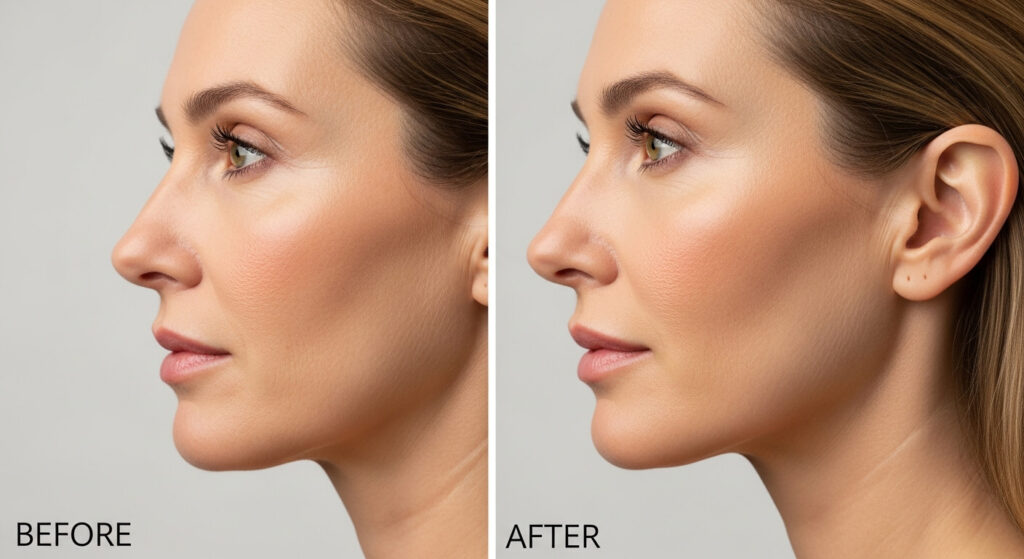
Far more common and far less discussed are the outcomes that don’t threaten health but significantly affect appearance: filler that migrated over time into an unintended position, overcorrected lips that a patient never wanted, Botox that was placed slightly off and left one brow lower than the other, a face that received filler appointment after appointment for years without anyone stepping back to assess whether the cumulative result still made sense. Every experienced provider sees these patients. They come in not for elective improvement but because something is wrong and they need someone who can actually help.
What Type of Problem You’re Dealing With
The approach to correction depends almost entirely on what went wrong and with what product. These are not interchangeable situations.
Migrated or excessive hyaluronic acid filler
This is the most common category. HA fillers — Juvederm, Restylane, Belotero, and related products — are dissolvable with hyaluronidase, an enzyme that breaks down hyaluronic acid chains and allows the body to reabsorb the product. When filler has been placed too superficially, in the wrong tissue plane, in quantities that have accumulated beyond what looks natural, or in an area like the under-eye where the tissue is extremely unforgiving, hyaluronidase can produce dramatic correction. The puffiness resolves. The distortion softens. In cases where patients have lived with the problem for months, seeing what their face looks like after dissolution is often an emotional experience.
The details matter, though. Hyaluronidase dissolves all HA in the treated area, including the body’s own. Too aggressive a dose in the wrong location leaves the tissue depleted and hollowed, which trades one problem for another. Knowing how much product is present, where it is, and how to target the enzyme appropriately requires clinical experience and physical assessment skills that not every provider has.
Hyaluronidase also does nothing for non-HA products. Radiesse, Sculptra, Bellafill, any permanent filler — none of these respond to the enzyme. If the problem involves one of these products, the correction approach is entirely different and considerably more complex.
Botox that landed wrong
The saving grace with Botox complications is that they’re temporary. The product wears off. But “temporary” covers a range of timelines that feel very different to live through — a dropped brow typically persists for six to ten weeks, sometimes longer.
In specific situations, targeted Botox placed in compensatory locations can partially counteract a bad result. Relaxing a muscle that’s pulling in the wrong direction, correcting residual asymmetry, adjusting the brow position by treating the muscle responsible for pulling it down — these are precise, anatomy-specific maneuvers that require real knowledge to execute correctly. They’re not always possible, and they’re not always enough. Sometimes the honest answer is to wait, manage the situation as well as possible in the interim, and plan more carefully for the next treatment.
Nodules and delayed inflammatory reactions
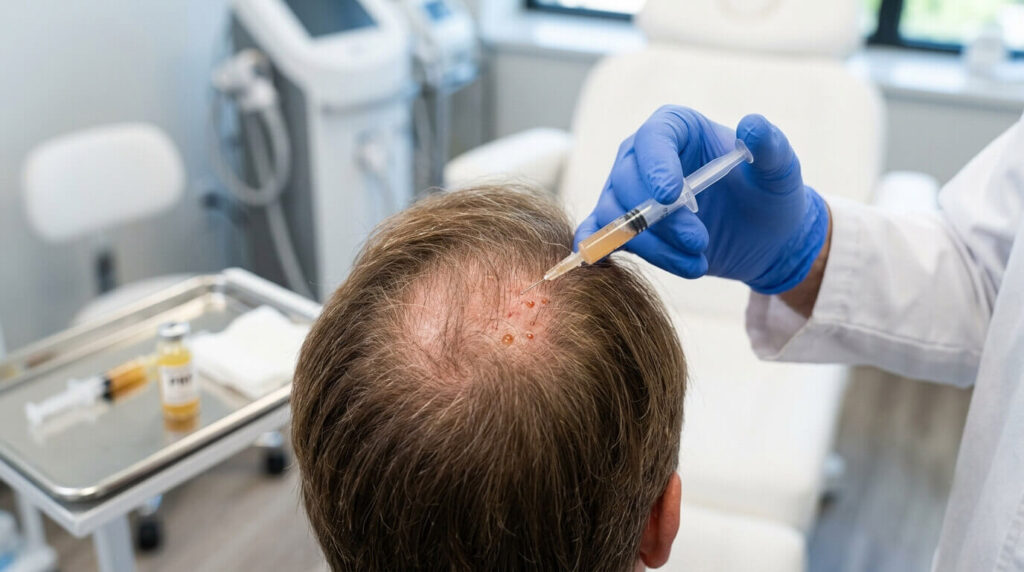
Certain filler products — particularly older permanent or semi-permanent fillers, but occasionally standard HA products in susceptible patients — can produce delayed inflammatory nodules that appear weeks to years after treatment. These are among the more difficult outcomes to manage. Depending on the product and the nature of the reaction, options include intralesional steroid injections, hyaluronidase for HA-based nodules, or in some cases surgical removal. Anyone dealing with this situation needs a provider who has specifically managed it before, not someone encountering it for the first time.
The Tyndall effect
A blue-grey discoloration visible through the skin over an injected area, caused by HA filler placed too superficially. It’s most common under the eyes where the skin is less than half a millimeter thick. Treatable with hyaluronidase when a skilled provider addresses it — but the eye area requires particular care given what’s nearby.
Years of cumulative treatment that drifted somewhere wrong
This category is harder to define and harder to correct because there’s no single incident, no single product, no discrete problem with a clear technical fix. Faces that have been treated repeatedly over years sometimes accumulate a result that looks altered in a way the patient can’t fully articulate but feels clearly. The volume distribution is off. The contours don’t match the underlying bone structure. The face looks like it’s carrying something that shouldn’t be there.
Addressing this requires a provider who can assess the face as a whole, understand what’s been placed and where, and develop a realistic plan for unwinding it — which often involves allowing some things to dissolve naturally, actively dissolving others, and not adding anything new until the underlying anatomy is visible again. It’s a process that takes months, not an appointment.
What Actually Happens at a Correction Consultation
A correction consultation is mostly listening and looking. Any provider who moves quickly toward a treatment plan without spending substantial time on history and assessment is not approaching this correctly.
The history matters: what products have been used, by which providers, in what quantities, how recently. This is often hard to reconstruct. Patients don’t always know what they received — they may know “filler” without knowing which product or how much. Providers aren’t always forthcoming about their protocols. And patients who’ve seen multiple people over several years may have genuinely incomplete records.
A skilled provider gathers information from the tissue itself — how it feels on palpation, how it moves, where the fullness sits, how it responds to pressure. This physical assessment can reveal a great deal about what’s present even without a complete history. Imaging is occasionally useful for characterizing what’s in the tissue before any intervention.
The conversation after assessment needs to be honest about what’s achievable. Some outcomes correct fully and relatively quickly. Some correct partially. Some require waiting for product to metabolize before intervention makes sense. And some have produced changes that can’t be completely reversed, either because the product isn’t dissolvable or because the tissue has been altered in ways that don’t simply undo.
A provider who promises complete correction of anything without thorough assessment first is not being straight with you.
Who Should Be Doing This Work
Correction work is not a specialty that shows up on a list of qualifications. It’s developed through experience with a specific patient population, and the providers who are genuinely good at it are the ones who have done it repeatedly and taken the outcomes seriously.
The skill set required goes beyond routine aesthetic treatment. Assessing tissue that has been altered by previous procedures, recognizing when products from different treatments are interacting in the same area, knowing how to dose hyaluronidase conservatively for complex situations, looking at a face that has drifted over years and understanding what its underlying structure actually is — these are things that develop through specific clinical exposure. A provider who rarely sees correction cases is encountering each scenario relatively fresh, which is not ideal when the situation is already complicated.
Beyond technical skill, the right provider for correction work brings a particular kind of honesty to the consultation. They’ll tell you what they see rather than what you want to hear. They’ll be clear about timelines that may be longer than you’d like. They’ll tell you when the right answer is to wait rather than to intervene immediately. And if what you’re describing is not actually a significant problem — if your perception of the result is outside the range of what correction would address — they’ll say that too, which is both harder and more respectful than agreeing with everything.
Victoria Ervin at Ervin Beauty sees correction patients as a deliberate part of her practice, not an accommodation she makes reluctantly. Patients come specifically because something went wrong elsewhere and they need someone with the clinical depth and the candor to work through it. That background shapes everything about how treatment is approached at the clinic — the emphasis on assessment, on natural outcomes, on conservative philosophy in the best sense of that word.
Recognizing Good Aesthetic Practice Before Something Goes Wrong
The best correction is not needing one. Most of the outcomes described in this article are not random events. They’re the predictable result of specific provider behaviors: skipping adequate assessment, prioritizing appointment throughput over individual protocols, using diluted product, adding volume without evaluating what’s already there, and not being available when problems arise.
Before treatment, a few things are worth paying attention to.
A provider who begins treatment without a detailed history and physical assessment of your face is missing the most important step. What products you’ve had, what your anatomy looks like, how your skin responds, what’s already present in your tissue — all of this determines what’s appropriate. Skipping it in the interest of getting started is a red flag.
When a provider can only see the problem you’ve come in pointing at rather than assessing the full picture, the treatment they recommend will reflect that limited view. The face changes systemically with age and with treatment. Addressing one area in isolation, without considering what’s happening elsewhere, produces results that may look correct in one spot and wrong overall.
Straightforward questions about what you’re being injected with, in what quantity, and how the product was prepared should get straightforward answers. Any deflection on these questions is informative.
And after treatment: a provider who is not accessible when questions arise during recovery, who treats the appointment as the endpoint of the interaction, is leaving a gap in care that can matter when something unexpected happens.
The Emotional Reality of Getting Here
Patients who come for correction appointments are not dealing with a neutral technical problem. They are dealing with months, sometimes years, of looking in the mirror at a result that upsets them — and often doing it alone, either because they feel embarrassed to talk about it or because the people around them don’t understand why it matters as much as it does.
This is worth naming because it affects what a correction consultation actually needs to accomplish. It needs to provide honest clinical assessment and a realistic plan. But it also needs to be a conversation between a provider who takes the situation seriously and a patient who has been let down and is deciding whether to trust someone again.
Getting that right requires more than technical competence. It requires the kind of straightforward human decency that treats what the patient is feeling as real, addresses it honestly, and doesn’t minimize either the problem or the path to resolving it.
Patients who have had this experience — the conversation that is both competent and honest — describe it consistently as a turning point, not just in resolving the physical outcome but in making the whole experience feel manageable again. That’s what correction treatment looks like when it’s done well.
Frequently Asked Questions
Does hyaluronidase work on all fillers? Only on hyaluronic acid products — Juvederm, Restylane, Belotero, and similar. Radiesse, Sculptra, Bellafill, and any permanent filler don’t respond to it. The correction approach for non-HA products depends entirely on which product was used and what the problem is.
How fast does hyaluronidase work? Changes are usually visible within 24 to 48 hours. The tissue continues settling over several weeks as the body reabsorbs the dissolved product. Multiple sessions are sometimes needed when significant product is present.
I don’t know what filler I had. Can anything still be done? Physical assessment provides a lot of information even without complete history. A test dose of hyaluronidase in a small area can help determine whether HA is present. An experienced provider will work through the assessment rather than requiring documentation that may not exist.
Can bad Botox be fixed immediately? In some cases, targeted placement of additional Botox can partially counteract the wrong result — this is specific to the anatomy of the situation and not always possible. For outcomes that can’t be addressed with additional product, time resolves it. Most Botox complications clear within 8 to 12 weeks.
Will I look worse before I look better after filler dissolution? Sometimes, yes. Dissolving filler reveals the underlying volume loss it was masking. The tissue needs several weeks to settle before the true corrected baseline is visible and before any new treatment makes sense. This is a normal part of the process.
How long after dissolution before I can have new filler? Most providers wait four to six weeks minimum after hyaluronidase before placing new product, to allow the tissue to fully settle. After more extensive correction, the timeline may be longer. The correction consultation is where this gets determined based on your specific situation.
How do I find someone genuinely qualified to do this? Look for providers who specifically see correction cases as a regular part of their practice, who have a genuine medical background, and whose consultation approach is assessment-first rather than treatment-first. A provider who offers to fix everything immediately without thorough examination of what’s there is not the right person for this.