There’s a particular kind of skin frustration that doesn’t get talked about enough – the frustration of skin that’s fundamentally healthy but visually inconsistent. No significant wrinkles, good texture, decent firmness. But the tone is uneven. There are brown spots from years of sun exposure that foundation covers but never quite matches. A redness across the cheeks and nose that flares unpredictably. A dullness that makes the face look flat and tired even after a full night of sleep. The skin doesn’t look damaged in any dramatic way. It just doesn’t look like itself.
This is the category of concern that BBL Photofacial was designed for – and where it performs better than virtually anything else available in non-surgical aesthetics.
BBL, or BroadBand Light, is not a laser. It’s not a chemical treatment. It’s not something that removes a layer of skin and asks you to hide for two weeks. It’s a light-based treatment that works selectively – targeting the chromophores responsible for pigmentation irregularities and vascular redness without disturbing the surrounding tissue. The result, over a series of treatments, is skin that looks genuinely even, clear, and radiant in a way that no skincare product and no makeup technique can replicate. Just skin – at its actual best.
What BBL Is and How It Works
BBL stands for BroadBand Light. It’s delivered by a device manufactured by Sciton – one of the most respected names in medical-grade aesthetic technology – and it represents a significant evolution beyond the IPL devices that came before it.
The technology works on the principle of selective photothermolysis. In plain language: specific wavelengths of light are selectively absorbed by specific targets in the skin – melanin (the pigment responsible for brown spots and sun damage) and oxyhemoglobin (the component of blood that causes redness and visible vessels). The light energy is absorbed by those targets, converted to heat, and that heat destroys the unwanted cells or collapses the unwanted vessels – without affecting the surrounding tissue.
What makes BBL different from standard IPL is the sophistication of the delivery system. BBL delivers light in a broader spectrum with more precise control over the wavelengths, fluence, and pulse duration used for each patient. This allows the treatment to be genuinely customized – adjusted for different skin tones, different concerns, different areas of the face – rather than applying a fixed protocol that produces average results for an average patient.
The treatment also has a compelling body of research behind it that goes beyond cosmetic improvement. A landmark Stanford study examined the skin of patients who had received regular BBL treatments over years and found that their gene expression profile – the way their skin cells behaved at a molecular level – more closely resembled younger skin than their chronological age would predict. BBL doesn’t just improve the appearance of the skin. At the cellular level, it may genuinely slow certain aspects of how the skin ages. This is a finding that has made BBL one of the most scientifically interesting treatments in aesthetic medicine, not just one of the most popular.
What BBL Treats
BBL is particularly well-suited to a cluster of concerns that are closely related – most of them stemming from sun exposure, vascular irregularity, or the natural changes in melanin distribution that come with age.
Sun damage and age spots. Brown spots, sun spots, and the general uneven tanning pattern that accumulates over years of UV exposure are among the most responsive concerns to BBL treatment. The melanin in these hyperpigmented areas absorbs the light energy with high selectivity. In the days following treatment, the darkened spots will appear to deepen slightly – a process that looks alarming but is entirely expected – before rising to the surface and flaking away, revealing clearer skin beneath. The improvement from a single treatment can be striking. Over a series of treatments, the cumulative clearing of sun damage produces a dramatic, genuine improvement in overall skin tone.
Redness and rosacea. Rosacea is one of the most undertreated skin conditions in aesthetic medicine – partly because many patients manage it with foundation and skincare and don’t realize that a medical treatment can significantly reduce its visible impact. BBL targets the oxyhemoglobin in the dilated blood vessels responsible for the diffuse redness, flushing, and visible capillaries associated with rosacea. Treatment reduces background redness, minimizes flare-up intensity, and improves overall skin clarity. This is not a cure for rosacea – the condition has underlying triggers that require ongoing management – but BBL is the most effective non-invasive treatment available for its visible manifestations.
Visible facial vessels. The fine red vessels that appear on the nose, cheeks, and around the nostrils – telangiectasias – are collapsed by the heat generated when oxyhemoglobin absorbs the BBL energy. They fade and are gradually reabsorbed by the body. For patients bothered by visible vessels that have appeared over years of sun exposure, temperature fluctuation, or as part of a rosacea presentation, BBL produces visible improvement that is very difficult to achieve with any other non-surgical treatment.
Uneven skin tone and dullness. Beyond specific spots or vessels, many patients experience a general unevenness of tone – a patchiness, a lack of clarity – that makes the skin look inconsistent. BBL’s ability to address the melanin irregularities that create this patchiness, combined with the stimulation of skin renewal that follows treatment, produces an overall improvement in skin quality and luminosity that goes beyond what targeted spot treatment would suggest.
Early signs of aging and skin quality. The collagen-stimulating effect of the heat generated during BBL treatment contributes to improvements in skin texture and early fine lines over a series of treatments. While BBL is not primarily a collagen-building treatment the way CO2 laser or Morpheus8 are, the cumulative effect of regular BBL treatments on overall skin quality – and the research suggesting its effects at the cellular level – make it a cornerstone of proactive skin maintenance for patients who want to preserve what they have while addressing what has already changed.
BBL vs. IPL vs. Laser: Understanding the Differences
Because BBL is a light-based treatment and the word “laser” is used loosely in popular conversation, there’s significant confusion about how it compares to other technologies. Understanding the distinctions helps clarify what BBL is uniquely suited for.
BBL vs. Standard IPL. BBL is not the same as the generic IPL devices found in many medical spas. Standard IPL (Intense Pulsed Light) uses broad-spectrum light with less precise control over wavelength selection, pulse duration, and fluence. This results in treatments that are less customizable, less consistent, and potentially riskier on certain skin types. BBL by Sciton uses a more sophisticated delivery system with better filtration, more precise control, and a larger body of clinical evidence behind it. The device matters – and so does the distinction.
BBL vs. CO2 Laser. CO2 laser is a resurfacing treatment that removes layers of the epidermis and remodels the dermis. It’s transformative for texture, deep lines, and acne scarring, but it involves real downtime and significant recovery. BBL is a non-ablative treatment – it doesn’t remove surface skin. It targets specific chromophores within the intact skin. The two treatments address fundamentally different concerns and are not interchangeable. CO2 delivers what BBL cannot for texture and deeper resurfacing. BBL delivers what CO2 cannot for pigmentation, redness, and vascular irregularity. The most comprehensive treatment plans use both, sequenced appropriately.
BBL vs. Chemical Peels. Chemical peels address pigmentation and surface texture through controlled exfoliation. They can be effective for certain types of hyperpigmentation and general skin renewal, but they don’t selectively target melanin or oxyhemoglobin the way BBL does. For vascular concerns – redness, visible vessels, rosacea – peels offer no benefit. For the type of photodamage that accumulates over years of sun exposure, BBL’s selectivity and precision typically produce superior results with less recovery.
BBL vs. Topical Brightening Treatments. Vitamin C serums, kojic acid, niacinamide, and similar topical brightening agents support skin health and can gradually reduce the appearance of mild pigmentation over time. They cannot address sun spots that are deeply established, collapse visible vessels, or produce the chromophore-selective correction that BBL delivers. These treatments are not competitors – they complement each other as part of a comprehensive skincare approach.
The BBL Treatment Experience
Consultation. A thorough BBL consultation assesses your skin type, Fitzpatrick classification, the specific concerns you want to address, and your treatment history. Skin type matters significantly for BBL – the treatment parameters are adjusted based on melanin content in the skin to ensure efficacy without the risk of post-inflammatory hyperpigmentation. Patients with very dark skin tones require careful assessment, as higher melanin content in the epidermis requires adjusted protocols to avoid unintended pigmentation changes.
Preparation. In the weeks before treatment, sun avoidance is essential. Tanned skin has higher epidermal melanin, which can compete with the target melanin in sun spots for the light energy – reducing the treatment’s effectiveness and increasing the risk of surface reactions. Certain topical ingredients, including retinoids, should also be paused before treatment. Specific pre-treatment instructions are provided at consultation.
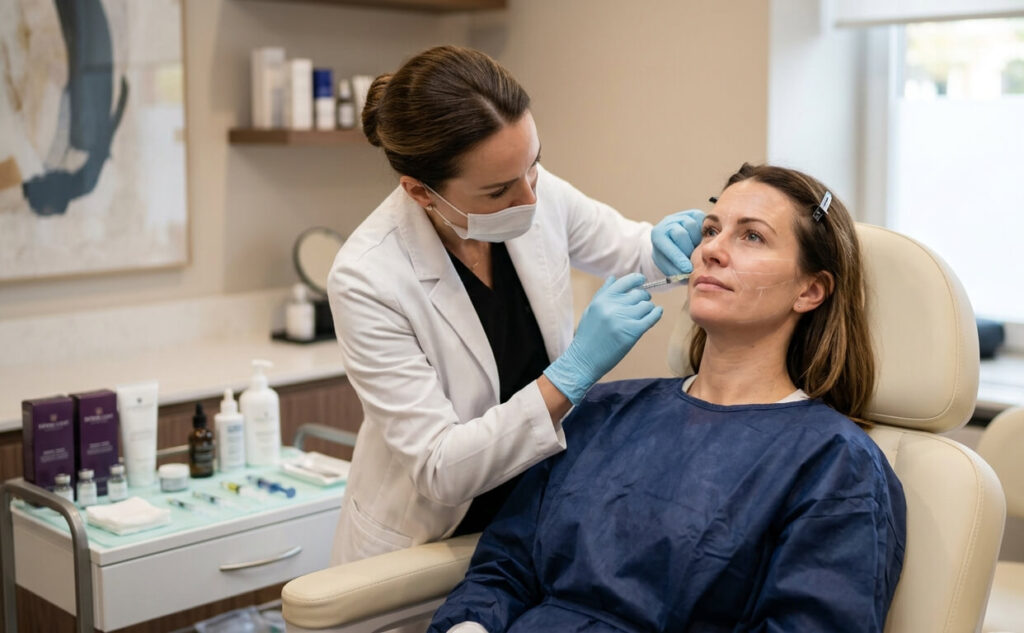
The procedure. BBL is performed with a cooling system that protects the surface of the skin as the light energy is delivered. A gel is applied to the treatment area, and the handpiece is moved across the skin in methodical passes. Most patients describe the sensation as a brief snap of warmth with each pulse – often compared to a rubber band flick. The procedure is well-tolerated without anesthesia for most patients. A full-face treatment typically takes 20 to 30 minutes.
Immediately after. The skin will appear slightly flushed, similar to mild sunburn. Brown spots being targeted often appear darker immediately following treatment – this is expected and is a sign that the treatment is working. The treated pigmentation is undergoing the process that will cause it to surface and resolve.
Recovery. BBL involves minimal downtime compared to ablative treatments. Most patients return to normal activities the same day or the following day. The darkened spots will begin to surface and flake away over the following 5 to 14 days – this process requires patience and gentle treatment of the skin. Scrubbing, picking, or attempting to accelerate the flaking is counterproductive and can cause irritation. Sun protection during this period is non-negotiable.
Results. Pigmentation improvements become visible as the treated spots resolve over one to two weeks. Vascular improvements – reduction in redness and visible vessels – are often noticeable more quickly, as the collapsed vessels are reabsorbed. The full improvement from a single treatment becomes apparent at around two to four weeks. Most patients achieve their best results with a series of two to four treatments spaced three to four weeks apart, followed by maintenance treatments once or twice a year.
BBL HERO: The Maintenance Protocol Worth Knowing About
One of the most significant developments in BBL treatment is the emergence of BBL HERO – a higher-fluence, faster-delivery version of the treatment designed for efficient maintenance and skin health preservation.
Where standard BBL is typically used to address existing concerns – clearing established sun damage, treating rosacea, targeting visible vessels – BBL HERO is designed as a regular maintenance protocol for patients who want to prevent the accumulation of new photodamage and maintain the cellular improvements that ongoing BBL treatment produces.
The Stanford research referenced earlier – showing that regular BBL recipients exhibited gene expression profiles resembling younger skin – was conducted on patients receiving ongoing treatments rather than single interventions. The maintenance approach is part of what makes BBL one of the most evidence-supported anti-aging protocols in aesthetic medicine, not just a reactive treatment for existing concerns.
For patients who are serious about their skin over the long term, establishing a regular BBL schedule alongside their skincare routine is among the most scientifically supported investments they can make.
Why Provider Selection Matters for BBL
BBL is available at many clinics, and this availability has created a wide variance in the quality of treatments patients receive. The device may be the same; the outcomes are not.
The variables that a skilled BBL provider must navigate include: appropriate parameter selection for each patient’s skin type and Fitzpatrick classification; the identification of concerns that are not appropriate for BBL at a given visit (active breakouts, recent tanning, certain medications that increase photosensitivity); the customization of wavelength filters for specific targets; and the clinical judgment to recognize when a patient’s concerns are better addressed by a different modality entirely.
A provider who applies a standard protocol without genuine assessment of the individual patient’s skin is not personalizing treatment – they’re running a device. The difference between a skilled, individualized BBL treatment and a generic one shows in results: more complete clearing of pigmentation, more consistent reduction of redness, fewer treatments required to achieve the target outcome.
At Ervin Beauty, BBL is approached with the same individualized clinical assessment that governs every treatment Victoria Ervin performs. Parameters are selected based on your specific skin and specific concerns. The treatment is part of a broader conversation about your skin health over time, not an isolated appointment. And the follow-up that happens after your treatment – the accessibility, the monitoring, the ability to ask questions as your skin heals and changes – is part of what makes the experience of care genuinely different.
Who Is the Right Candidate for BBL?
BBL produces its best results in patients who:
Have accumulated sun damage – brown spots, uneven tanning, age spots – from years of UV exposure and want to address it meaningfully rather than just covering it.
Struggle with redness, rosacea, or visible facial vessels that affect their skin’s appearance and haven’t found satisfying solutions in topical treatments or skincare.
Have good overall skin quality but are bothered by tone inconsistency that makes the skin look uneven or dull.
Are proactive about skin health and want to invest in a treatment with a genuine evidence base for long-term skin quality preservation.
Are realistic about the process – BBL produces cumulative results over a series of treatments, and maintenance is part of the protocol.
Can commit to strict sun avoidance before and after treatment.
BBL requires careful assessment for patients with darker skin tones, active inflammatory skin conditions, or a history of melasma (in which case light-based treatments may worsen pigmentation rather than improve it). A thorough consultation will identify whether BBL is the right approach or whether a different treatment modality is more appropriate for your specific situation.
Frequently Asked Questions
How many BBL treatments will I need? For most patients addressing established sun damage and redness, a series of two to four treatments spaced three to four weeks apart produces the best initial results. Maintenance treatments once or twice a year support and extend those results over the long term.
Does BBL hurt? The sensation is typically described as brief snaps of warmth with each pulse – similar to a rubber band flick. Most patients find it very manageable without anesthesia. A cooling system protects the skin surface throughout treatment.
Can BBL be combined with other treatments? Yes. BBL pairs well with other treatments as part of a comprehensive skin health plan. It’s commonly combined with CO2 laser (sequenced appropriately), Morpheus8, and professional skincare protocols. The timing of combination treatments is discussed at consultation.
What happens to the dark spots after treatment? The targeted melanin undergoes a process called “peppering” – the spots appear darker in the days immediately following treatment before rising to the surface and flaking away. This is the intended response and a sign the treatment is working. The process completes within one to two weeks.
Is BBL safe for all skin types? BBL is safe and effective for a wide range of skin types, but parameters must be carefully adjusted based on Fitzpatrick classification. Very dark skin tones require specific protocols and careful assessment. Your provider will determine whether BBL is appropriate for your skin type and what parameters are correct for your treatment.
How long do BBL results last? The clearing of existing sun damage and visible vessels is long-lasting, but new photodamage will accumulate with continued sun exposure over time. This is why ongoing maintenance is part of the BBL protocol for patients who want to preserve their results.
Ready to See Your Skin at Its Clearest?
If uneven tone, sun damage, or persistent redness has been the concern you’ve been unable to resolve with products and routine treatments, BBL is worth an honest conversation about what it can do for your specific skin.
Ervin Beauty currently offers an introductory offer for first-time BBL patients. The consultation fee is applied toward your first treatment.