Hair thinning is one of the most emotionally significant aesthetic concerns patients bring to aesthetic medicine, and one of the least straightforwardly addressed. The treatments available range from topical applications and oral medications to surgical transplantation — each with a different mechanism, a different risk profile, and a different place in the clinical picture depending on the nature and stage of the hair loss.
PRP and PRF for hair restoration occupy a specific position in this landscape. They’re not a replacement for pharmacological treatment in patients who need it. They’re not hair transplant surgery. What they offer is a biological intervention that addresses the health of the hair follicle and the scalp environment — using the patient’s own growth factors to support the follicles that are still present and slow the progression of their decline. For the right patient at the right stage of hair loss, the results are meaningful enough to make the treatment one of the more frequently requested procedures in regenerative aesthetics.
What Causes Hair Thinning — and Why It Matters for Treatment
Hair loss is not a single condition. Understanding which mechanism is driving the thinning in a given patient is the starting point for any sensible treatment decision.
Androgenetic alopecia — the most common form of hair loss in both men and women — is driven by the effect of dihydrotestosterone (DHT) on genetically susceptible follicles. DHT, a derivative of testosterone, causes a progressive miniaturization of these follicles: over time, the hairs they produce become finer, shorter, and lighter until the follicle eventually produces no visible hair at all. In men, this produces the characteristic receding hairline and crown thinning. In women, the pattern is typically more diffuse — a widening of the central part and generalized thinning across the top of the scalp, usually without the complete bald patches more common in male pattern hair loss.
The critical detail about androgenetic alopecia is that the follicles don’t disappear immediately — there is a period of progressive miniaturization during which the follicle is still present and potentially responsive to treatment. Once a follicle has been miniaturized to the point of complete dormancy, the window for non-surgical regenerative treatment has closed. This is why early intervention matters more in hair loss than in many other aesthetic concerns.
Telogen effluvium is a diffuse shedding pattern triggered by a physiological stressor — significant physical illness, major surgery, childbirth, rapid weight loss, or prolonged psychological stress. The stressor shifts a large proportion of follicles simultaneously into the resting (telogen) phase, producing noticeable shedding two to four months later when those follicles reach the end of their resting phase and release the hair. Telogen effluvium is typically self-limiting if the trigger resolves, but it can be distressing while ongoing, and treatments that support follicle health can help accelerate recovery.
Alopecia areata is an autoimmune condition in which the immune system attacks hair follicles, producing patchy hair loss. This is a distinct condition with a different treatment approach from androgenetic alopecia, and the role of PRP in its management is less well-established than for androgenetic alopecia.
The clinical assessment of what’s driving a patient’s hair loss — and how far advanced it is — determines whether PRP or PRF is an appropriate treatment, what outcomes are realistic, and how it fits within a broader management plan.
How PRP and PRF Work in the Scalp
The mechanism is the same as in other PRP applications: concentrated platelets from the patient’s own blood release growth factors that signal local cells to repair, regenerate, and produce structural proteins. In the scalp, the targets of these growth factors are the follicular cells — the dermal papilla cells that govern hair follicle cycling and the matrix cells that produce the hair shaft.
The growth factors most relevant to hair follicle biology include platelet-derived growth factor (PDGF), vascular endothelial growth factor (VEGF), epidermal growth factor (EGF), and transforming growth factor beta (TGF-β). Together, these signals influence the follicle in several ways: promoting the transition from resting to active growth phase, extending the duration of the active growth phase, improving blood supply to the follicle, and reducing the inflammatory microenvironment that accelerates follicle miniaturization in androgenetic alopecia.
The effect on individual follicles is not dramatic or immediate. PRP and PRF do not rescue terminally miniaturized follicles. What they do is support the follicles that are in the process of declining — stabilizing them, improving their function, and in a meaningful proportion of patients producing measurable improvements in hair density, shaft thickness, and the ratio of follicles in active versus resting phase.
PRF versus PRP. As discussed in the context of under-eye treatment, PRF is processed without anticoagulant, producing a higher platelet concentration and a fibrin matrix that slows the release of growth factors. In the scalp, this sustained release is an advantage — rather than a single burst of growth factor signaling that diminishes quickly, PRF creates a prolonged environment of follicle-supportive signals over the days and weeks following injection. Most providers with experience in both find PRF to produce more consistent results for hair restoration than standard PRP, and many have largely shifted to PRF for this indication.
What the Research Shows
The published clinical evidence for PRP and PRF in hair loss is stronger than for many aesthetic treatments and has grown considerably over the last decade. Multiple randomized controlled trials have demonstrated statistically significant improvements in hair density, shaft diameter, and patient-reported outcomes in patients with androgenetic alopecia treated with PRP compared to control groups.
A systematic review published in the Journal of the American Academy of Dermatology found that PRP treatment produced improvements in hair density measured by phototrichogram and patient satisfaction ratings across the majority of included studies, with a favorable safety profile. More recent studies on PRF have shown results consistent with or exceeding those of standard PRP.
What the evidence also shows is that results are variable — not everyone responds at the same level, and the degree of improvement depends on the stage of hair loss, the frequency of treatment, and the platelet concentration achieved. Studies using more concentrated preparations and multiple initial sessions consistently report better outcomes than those using fewer sessions and lower concentrations.
The honest clinical picture is that PRP and PRF for hair restoration are genuinely evidence-supported, but they work best when introduced before hair loss is severe, and they work better as part of an ongoing maintenance strategy than as a one-time intervention.
The Treatment Protocol
Consultation and assessment. A thorough assessment covers the pattern and stage of hair loss, family history (relevant for androgenetic alopecia), any medical conditions or medications that might be contributing, and what previous treatments have been tried. Phototrichogram or trichoscopy — detailed imaging of the scalp and follicles — provides an objective baseline for tracking response to treatment.
Blood draw and processing. The processing is identical to PRP/PRF elsewhere: a small volume of blood is drawn and centrifuged to isolate the platelet-rich fraction. For PRF, the centrifuge protocol is adjusted to avoid the anticoagulant separation that characterizes standard PRP.
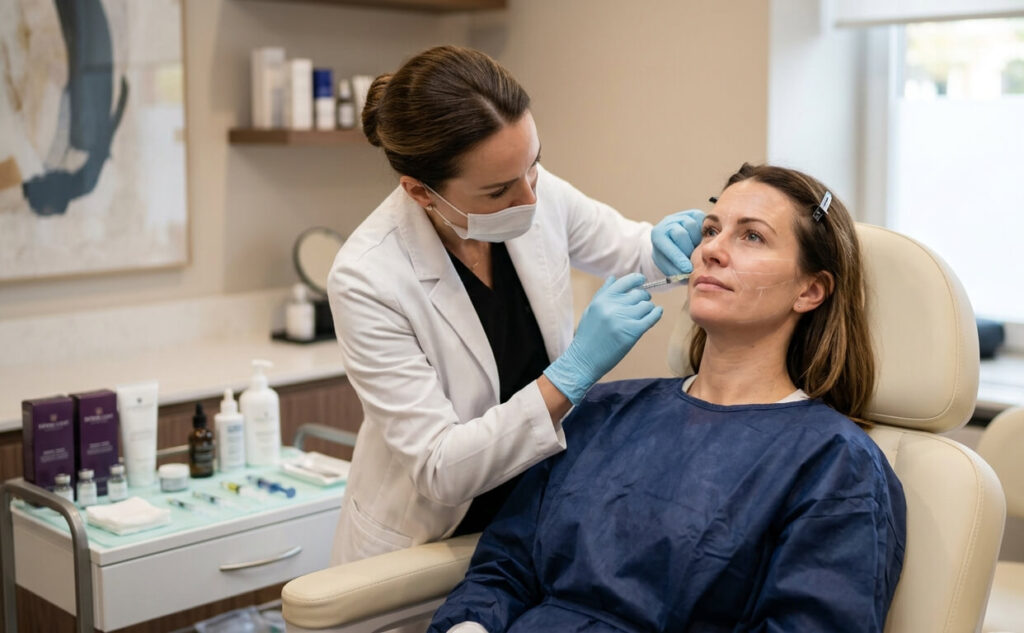
Scalp injection. The PRP or PRF is injected into the scalp in a series of small intradermal or subdermal injections across the treatment area. The injection pattern covers the zone of active thinning systematically. A microneedling step before injection is sometimes used — the microinjuries created by microneedling may enhance the penetration of the growth factors and amplify the follicle response.
Comfort. Scalp injections are tolerable for most patients without anesthesia, though a topical or injected local anesthetic can be used in patients with lower pain tolerance. The treatment takes 30 to 45 minutes from blood draw to completion.
Session frequency. The initial course typically involves three to four monthly sessions, after which maintenance treatments every three to six months sustain the growth factor environment. Patients who undergo an initial course and then stop treatment entirely typically find their results gradually regress over one to two years — an important consideration for realistic planning.
Combining PRP/PRF With Other Hair Loss Treatments
PRP and PRF for hair restoration are not an either/or decision relative to other treatments. They work alongside other modalities and often produce better results in combination than alone.
Minoxidil (topical or oral). Minoxidil is the most widely used topical treatment for androgenetic alopecia and works through a different mechanism — vasodilation that extends the anagen phase. It complements PRP’s growth factor signaling well, and combination studies suggest better outcomes than either treatment alone.
Finasteride and dutasteride (oral DHT inhibitors). These medications block the conversion of testosterone to DHT, addressing the hormonal driver of androgenetic alopecia directly. In patients with active androgenetic alopecia, particularly when hair loss is progressing, combining DHT inhibition with PRP removes the primary driver while supporting follicle health.
Low-level laser therapy (LLLT). Devices that deliver red and near-infrared light to the scalp stimulate follicle activity through a different mechanism again — photobiomodulation. Used consistently alongside PRP, some patients find a synergistic effect.
Hair transplant surgery. PRP is frequently used as an adjunct to hair transplant procedures — either to improve graft survival rates when applied at the time of transplantation, or to support the donor and recipient areas in the months following surgery. Patients who have had transplants and want to maintain the non-transplanted follicles in areas prone to future thinning are often good candidates for ongoing PRP maintenance.
Realistic Expectations
Patients sometimes approach hair restoration treatments with expectations shaped by dramatic before-and-after images that represent the best possible outcomes. Setting accurate expectations is a core responsibility of any provider discussing this treatment.
PRP and PRF for hair restoration, in the right patient at the right stage, produce measurable improvements in hair density and quality that are visible both subjectively and in objective measurements like phototrichogram. Patients whose hair loss is early to moderate typically see the most satisfying results. Patients with advanced hair loss — large areas with complete or near-complete follicle miniaturization — see less benefit because the follicles that would respond to the growth factor signals are no longer there.
Results take time to become visible. The follicle response to PRP signals plays out over the hair cycling timeline — months, not weeks. Most patients begin noticing improvement at three to six months after starting treatment, with the clearest picture emerging at nine to twelve months.
And results require maintenance. Hair loss in androgenetic alopecia is an ongoing biological process. PRP supports the follicles while it’s being applied; it doesn’t permanently alter the hormonal environment that drives the loss. Patients who respond well to treatment and want to maintain that response need to treat this as an ongoing part of their hair health strategy, not a course that finishes.
Who Is a Good Candidate
The clearest candidates for PRP/PRF hair restoration are patients with androgenetic alopecia in its early to moderate stages — where miniaturization is active but significant viable follicle population remains, and where the patient is motivated to slow progression and improve the quality of existing hair.
Patients with telogen effluvium often respond well to a shorter course of treatment that supports follicle recovery while the triggering stressor resolves.
Patients with very advanced hair loss, with large areas of complete baldness, or with scarring alopecia (in which the follicles are destroyed rather than miniaturized) are less likely to benefit significantly from PRP alone, and should have a realistic conversation about what combination of treatments makes sense.
Frequently Asked Questions
Initial improvement is typically noticeable at three to six months. The full picture of the treatment’s effect develops over nine to twelve months. This timeline reflects the speed of hair follicle cycling and collagen remodeling — it can’t be accelerated.
The injections are tolerable for most patients without anesthesia. Topical anesthetic cream applied before the session reduces discomfort substantially for those who are more sensitive.
These treatments work through different mechanisms and are genuinely complementary rather than competitive. Minoxidil extends the growth phase through vasodilation; PRP supplies growth factor signaling to the follicle. Both together tend to produce better results than either alone.
Yes, and women represent a significant portion of hair restoration patients. The diffuse thinning pattern typical of female androgenetic alopecia responds well to PRP treatment, and the treatment is appropriate across a wide age range.
Most providers with significant experience in both tend to use PRF for hair restoration, based on the higher platelet concentration and the sustained release of growth factors. Clinical studies comparing the two head-to-head are limited, but PRF’s biological advantages are logical and most experienced providers have observed consistent results.
Results are maintained while treatment continues and for a period after — typically one to two years before regression becomes noticeable. Patients who see good results and stop treatment entirely tend to gradually return toward their pre-treatment baseline. This is why ongoing maintenance is the standard recommendation rather than a finite treatment course.