The under-eye area is one of the most universally frustrating concerns in skincare — and one of the most poorly served. Ask anyone who has struggled with dark circles, hollowness, fine lines, or persistent puffiness under their eyes, and you’ll hear a version of the same story. They’ve tried the eye creams. The expensive ones, the ones with peptides and retinol and caffeine and vitamin C. They’ve tried cold spoons in the morning, more sleep, less sodium, more water. They’ve tried concealer in seventeen shades.
And the under-eye area looked more or less the same.
This is not a product problem. It’s a biology problem. The skin under the eyes is the thinnest skin on the face — roughly 0.5mm compared to 2mm elsewhere — and it sits directly over a network of delicate vasculature, thin fat compartments, and a muscle layer that controls every blink and squint. The changes that occur in this area with age — hollowing, the appearance of dark circles, fine crepey lines, loss of fullness — are structural. They happen in the tissue. A topical product cannot reach them.
PRP under-eye treatment can. And the results, for the right patient with the right provider, are the kind that make people stop reaching for the concealer.
What Is PRP and Why Does It Work Under the Eyes
PRP stands for platelet-rich plasma. It sounds clinical — and it is — but the concept is elegantly simple. A small amount of your own blood is drawn, placed into a centrifuge, and spun at high speed to separate its components. What separates out is platelet-rich plasma: a concentration of your own platelets, far higher than what circulates naturally in your bloodstream, suspended in plasma.
Why does this matter? Because platelets are not just the component responsible for clotting. They are the body’s primary delivery mechanism for growth factors — signaling proteins that communicate with cells to initiate repair, regeneration, and new tissue formation. When you cut yourself and a platelet-rich environment forms at the site of injury, what those platelets are doing is releasing growth factors that tell the surrounding cells to produce new collagen, generate new blood vessels, and rebuild the tissue.
PRP treatment uses this same biological process deliberately and precisely. When concentrated platelet-rich plasma is injected into the under-eye area, it releases growth factors that stimulate:
- New collagen and elastin production in the extremely thin dermal layer beneath the eyes
- Improved microcirculation, which reduces the vascular component of dark circles
- Tissue regeneration that gradually restores volume and structural integrity to the hollowing that creates the “sunken” appearance many patients describe
- Improved skin quality and thickness in an area that has virtually no capacity for topical product absorption
The key phrase here is your own biological material. PRP is not a foreign substance. It’s not a filler, not a toxin, not a synthetic compound. It’s a concentrated version of what your own body already produces for healing and regeneration — applied precisely where the regeneration is needed.
This is exactly why PRP under eyes has become one of the most requested treatments in medical aesthetics, and why patients who’ve tried it talk about it differently from most other procedures they’ve done.
What PRP Under Eyes Actually Addresses
The under-eye area presents a cluster of concerns that often occur together and compound each other visually. Understanding what PRP targets — and what it doesn’t — is important for setting accurate expectations.
Hollowness and the tear trough. The tear trough is the groove that runs from the inner corner of the eye down toward the cheek. As facial fat redistributes with age and volume decreases, this groove deepens and creates a shadow that reads as darkness and fatigue. PRP stimulates new tissue and collagen in this area, gradually filling in the hollow and reducing the shadow. This is a progressive improvement that develops over weeks and months — not the immediate volumizing effect of filler, but a regenerative one that produces skin that looks genuinely healthier rather than filled.
Dark circles from vascular visibility. One of the main contributors to dark circles — particularly in patients with thinner skin — is the visibility of the underlying vasculature through the translucent skin beneath the eye. As skin thins with age or from UV exposure, the blue-purple of blood vessels beneath becomes increasingly apparent. PRP improves the microcirculation in the tissue and stimulates thickening of the dermal layer, reducing the translucency that makes these vessels visible.
Fine lines and crepey texture. The loss of collagen in under-eye skin leads to the fine, papery texture that forms particularly when smiling or squinting — and eventually becomes visible at rest. PRP’s collagen-stimulating effect improves skin quality and thickness in this area over time, reducing the appearance of fine lines and restoring a degree of structural integrity to skin that has lost it.
Dullness and skin quality. Even beyond specific structural concerns, the under-eye area often simply lacks the vitality and brightness that characterizes healthy skin. The growth factors in PRP improve overall tissue health in the area, and many patients notice an improvement in luminosity and skin quality that goes beyond what the structural changes alone would suggest.
What PRP doesn’t fully address. PRP is not the right primary treatment for significant hollowness requiring immediate volume correction — that’s where hyaluronic acid filler remains the more appropriate tool. PRP is also not primarily indicated for pigmentation that is truly melanin-based rather than vascular or structural in origin. A thorough assessment at consultation will determine what combination of approaches makes sense for your specific under-eye anatomy and concerns.
PRP vs. PRF vs. EZGel: Understanding the Evolution
PRP has been used in aesthetic medicine for over a decade. In that time, the technology has evolved, producing two refinements that are worth understanding: PRF (platelet-rich fibrin) and EZGel.
PRF is drawn without the anticoagulant used in standard PRP processing. This results in a product with a higher concentration of platelets and growth factors, as well as a fibrin matrix — a natural scaffolding structure that holds the platelets in place at the injection site and allows for a slower, more sustained release of growth factors over time. The result is a more prolonged biological effect from the same treatment. PRF is increasingly preferred over standard PRP for under-eye work because the sustained release of growth factors produces more consistent and longer-lasting regenerative results.
EZGel is produced by heating the PRF to create a gel-like consistency — essentially a natural, autologous gel made entirely from your own blood components. Because it has a firmer consistency than liquid PRP or PRF, EZGel can provide a degree of immediate volumization in addition to its regenerative effects. It’s sometimes called a “natural filler” — a description that communicates the concept, though the mechanism is quite different from hyaluronic acid. EZGel is particularly useful in the tear trough area where some immediate structural support enhances the progressive regenerative effect.
The choice between PRP, PRF, and EZGel is made based on the patient’s specific anatomy, concerns, and what outcomes are being targeted. A provider who offers all three and understands the clinical indications for each is in a much better position to customize treatment than one who uses a single protocol for every patient.
The Procedure: What to Expect
Consultation. Assessment of the under-eye area in a PRP consultation is more nuanced than it might appear. The provider evaluates the relative contribution of different factors — fat loss and hollowness, skin thickness, pigmentation type, vascular visibility, skin quality — to determine what combination of PRP, PRF, or EZGel is appropriate, how it fits alongside any other treatments being considered, and what a realistic outcome looks like for your anatomy.
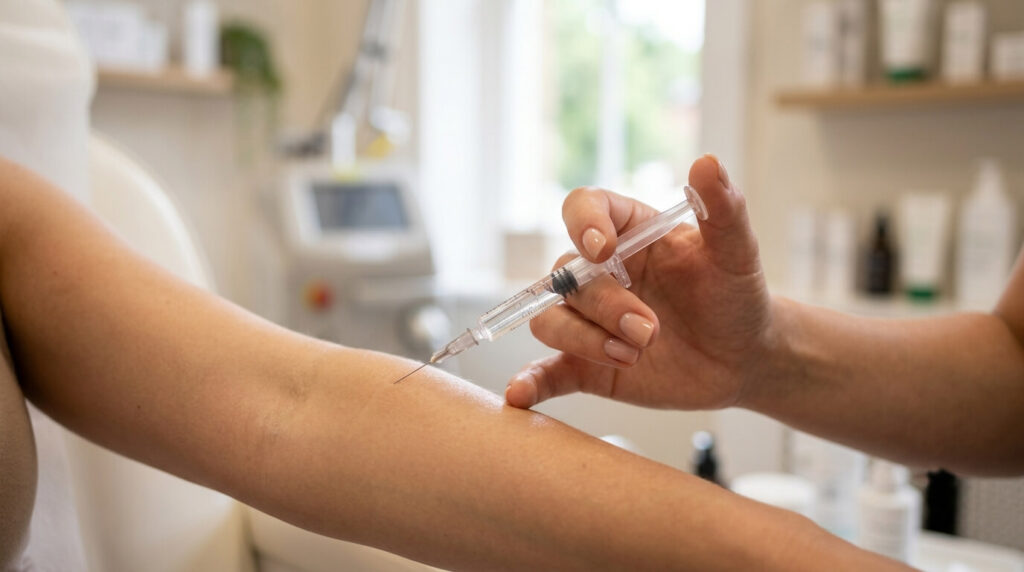
The blood draw. A small volume of blood — typically 10 to 20ml, similar to a standard lab draw — is taken from a vein in the arm. This is processed in the centrifuge while the skin is being prepared.
Preparation and comfort. A topical anesthetic is applied to the under-eye area and given time to work. Some patients experience mild anxiety about injections in this area; this is completely normal, and a good provider takes the time to ensure you’re comfortable before beginning.
The treatment. The concentrated PRP, PRF, or EZGel is injected into the under-eye area using a fine needle or cannula, depending on the technique and the specific area being addressed. The treatment itself is typically completed within 20 to 30 minutes. Most patients find it well-tolerated with adequate numbing.
Immediately after. Some swelling, mild bruising, and redness at the injection sites is normal and expected. The swelling in particular can be more pronounced than with other injection treatments because the under-eye tissue is extremely sensitive and reactive. Ice packs applied gently in the hours following treatment help manage this. Most patients are back to their normal routine within 24 to 48 hours.
What Results to Expect — and When
PRP under eyes is a regenerative treatment. This is one of its greatest strengths and one of the things patients most need to understand before treatment: results develop progressively over time rather than appearing immediately.
In the first few days after treatment, once any initial swelling resolves, the under-eye area may look similar to its pre-treatment state, perhaps with very early improvement. This is not a sign that the treatment isn’t working. The growth factors released by the platelets are signaling cells to begin collagen synthesis and tissue regeneration — a biological process that unfolds over weeks.
At 4 to 6 weeks, most patients begin noticing meaningful improvement. Skin texture looks better. Hollowness may be softening. Dark circles may appear lighter. The changes are cumulative.
At 3 months, the full picture of the first treatment becomes visible. For many patients, this is also when a second treatment is considered — not because the first didn’t work, but because PRP results build on each other, and a series of treatments produces deeper, more lasting regenerative changes than a single session.
By 6 months post-treatment, patients who have completed a series of treatments typically describe an under-eye area that looks genuinely different from baseline — not just improved, but qualitatively changed in a way that feels natural rather than treated.
Why the Under Eyes Respond So Well to PRP — and Why Provider Skill Matters More Here Than Elsewhere
The under-eye area is unforgiving. The skin is the thinnest on the face. The fat compartments beneath it are small and precisely distributed. The muscle layer is active with every facial expression. Injection into this area at the wrong depth, with the wrong technique, or using a product that is not appropriate for this tissue can produce prolonged swelling, visible product, asymmetry, or the Tyndall effect — a bluish discoloration caused by incorrectly placed hyaluronic acid, which is why many experienced providers prefer PRP or PRF for the tear trough over filler entirely.
PRP and PRF are biologically safe in a way that synthetic fillers are not — they are your own cells, and the body does not react to them as foreign material. But the injection technique still requires knowledge of the anatomy specific to this area, the right depth for different targets, and the clinical judgment to recognize when less is more.
A practitioner who is highly skilled in facial injections generally but has limited specific experience with under-eye PRP is not the same as one who has performed hundreds of treatments in this particular area. The tissue responds differently. The technique adapts accordingly. And the results reflect the difference.
At Ervin Beauty, PRP and PRF under-eye treatment is performed by Victoria Ervin — the same provider every time, not a rotating staff member. The protocol is individualized based on what each patient’s under-eye anatomy actually requires. And the post-treatment follow-up is built in: patients have access to Victoria throughout the recovery and results period, not just on appointment day. This continuity is particularly important for a treatment whose results develop over months — having someone to check in with, who knows your baseline and your treatment, makes a significant difference in the patient experience and in catching any early concerns that benefit from attention.
Why PRP at $90 Changed Everything — and What That Story Tells You
At Ervin Beauty, PRP under-eye treatment at an accessible price point became one of the most successful patient acquisition strategies the clinic had ever run. The waitlist extended three weeks. A single month closed at a level of revenue that most clinics don’t approach.
But the numbers are less interesting than the reason it worked so well.
It wasn’t just the price. It was the treatment itself — a procedure that genuinely delivers, performed by a provider who genuinely knows what she’s doing, on an area of the face that almost everyone has tried and failed to address with products. Patients came in for the under-eye treatment and experienced, often for the first time, what it feels like to be in the hands of a provider who takes their concern seriously and produces a real result.
And then they came back. For CO2 laser. For Morpheus8. For Sculptra. Because once you trust a provider, the conversation about what else could be better becomes a very different one.
This is what a well-designed entry treatment does when the quality behind it is genuine: it builds relationships, not transactions. The $90 PRP treatment is a front door. What’s behind it is a standard of care that patients don’t find everywhere — and don’t forget once they’ve experienced it.
Who Is an Ideal Candidate?
PRP under-eye treatment is appropriate for a wide range of patients. The best candidates include:
People who have noticed early to moderate hollowing in the tear trough area and want a regenerative, natural approach rather than immediate volumization with filler.
Patients whose dark circles have a vascular or structural component — visible blood vessels or loss of tissue volume — rather than being purely pigmentation-based.
Anyone who has been recommended tear trough filler but is concerned about the risks associated with injecting hyaluronic acid in this area, or who has had filler results they weren’t happy with.
Patients in their late 20s to 50s looking for preventive and regenerative approaches to early under-eye changes.
Patients who want to address under-eye concerns as part of a broader skin health and regeneration plan that includes treatments like Morpheus8, CO2 laser, or biostimulators.
PRP is not the primary recommendation for patients with severe volume loss requiring significant structural correction, or for those whose dark circles are predominantly due to constitutional hyperpigmentation with no vascular component. Assessment at consultation will make this clear.
Frequently Asked Questions
Most patients see meaningful improvement from a single treatment, but the best results come from a series of two to three sessions spaced four to six weeks apart. The cumulative effect of multiple treatments produces deeper tissue regeneration than a single session. Maintenance treatments once or twice a year support and prolong the results.
With adequate topical anesthesia, the treatment is well-tolerated by most patients. The under-eye area is sensitive, and some patients feel mild discomfort during injection, but this is typically brief and manageable. Post-treatment soreness resolves within a day or two.
It’s generally recommended to avoid makeup on the treated area for 24 hours following treatment to allow the micro-injection sites to close and reduce the risk of introducing bacteria. Your provider will give specific aftercare guidelines.
Yes. PRP is frequently combined with other treatments in a comprehensive approach to facial rejuvenation. It works particularly well alongside Morpheus8, CO2 laser, and biostimulators. The sequencing is important and will be discussed at consultation.
For many patients, yes. The higher concentration of growth factors and the sustained-release fibrin matrix in PRF produce results that are more consistent and longer-lasting than standard PRP. EZGel adds the benefit of immediate volumization in addition to regenerative effects. Victoria will assess which option is most appropriate for your specific anatomy.
Filler provides immediate, volumizing correction. It’s effective for significant hollowness but carries risks specific to the under-eye area — the Tyndall effect, prolonged swelling, rare but serious vascular complications. PRP and PRF produce gradual, regenerative improvement using your own biological material, with a significantly lower risk profile. For patients with mild to moderate concerns and a preference for a natural, biological approach, PRP or PRF is often the more appropriate first treatment.
Ready to See What PRP Can Do for Your Under Eyes?
If you’ve spent years trying to address your under-eye area with products and feeling like nothing quite reaches it, PRP treatment is worth an honest conversation with a provider who can assess whether it’s the right approach for your specific concerns.
Ervin Beauty currently offers a new client special on PRP under-eye treatment, and the consultation fee is applied toward your first treatment.