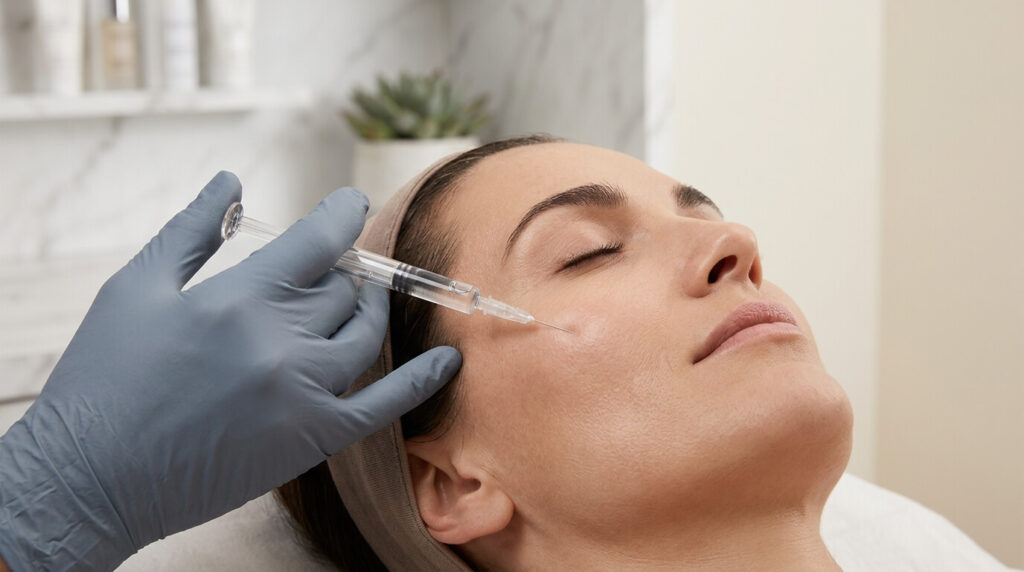
The average age of a first-time Botox patient has been dropping for years, and the reasoning behind it is less about chasing a trend and more about basic muscle mechanics. Wrinkles caused by repeated facial movement – frown lines, forehead creases, crow’s feet – start as temporary expressions that only show up when the face is active. Over years of the same movement repeated thousands of times, those temporary lines start etching themselves into the skin permanently, even at rest. Preventative Botox is built around a simple idea: treat the muscle activity early enough, and those lines never get the chance to become permanent in the first place.
At Ervin Beauty in Studio City, this has become one of the more common conversations with patients in their mid-20s to mid-30s – not because they’re trying to look older than they are, but because they’ve noticed a specific line starting to show up when they make an expression, and they want to understand whether it’s worth addressing now or waiting.
How Expression Lines Actually Form
Every time a facial muscle contracts – raising the eyebrows, squinting, frowning – the skin above it creases. In younger skin, that crease disappears completely once the muscle relaxes, because collagen and elastin are still doing enough work to snap the skin back to its resting position. This is why a 24-year-old can raise their eyebrows dramatically and see the forehead go smooth again seconds later.
Collagen production declines gradually starting in the mid-20s, and by the early-to-mid 30s, the skin’s capacity to fully recover from repeated creasing starts to lag slightly behind the rate at which those creases are happening. This is the exact window where a line that used to disappear completely starts leaving a faint trace behind, even after the expression relaxes. That faint trace is the first sign of what will eventually become a static, always-visible wrinkle if the underlying muscle activity continues unchanged.
Botox works by temporarily relaxing the specific muscle responsible for that repeated movement, which reduces how often and how forcefully the skin above it creases. Less repeated creasing means less cumulative strain on the collagen and elastin trying to keep that area smooth – which is the entire mechanism behind using it preventatively rather than waiting until the line is already permanent.
Who Actually Benefits From Starting Early
Not everyone in their 20s or 30s needs Botox, and the decision isn’t really about age as a number – it’s about expression patterns. The patients who tend to see the clearest benefit from starting early are the ones with naturally high facial expressivity: people who furrow their brow when concentrating, raise their eyebrows frequently when talking, or squint often, whether from habit or from something like screen time or LA’s sun exposure across most of the year.
A useful way to think about candidacy: if a line is visible during an expression but disappears completely once the face relaxes, that’s typically the ideal window for prevention. If the line is still faintly visible even with the face completely at rest, that’s a sign the transition from dynamic to static has already begun – Botox can still help slow further progression at that stage, but the framing shifts from purely preventative to a mix of prevention and early correction.
The forehead, the area between the brows (often called the glabella or “elevens”), and the outer corners of the eyes (crow’s feet) are the three areas where this pattern shows up earliest and most commonly, since they’re the muscles involved in the most frequently repeated expressions.
Why the Approach Differs From Corrective Botox
Preventative treatment uses meaningfully lower doses than corrective treatment for existing deep lines, and the goal is different in a way that changes the whole approach. Corrective Botox is often working to soften a line that’s already there. Preventative Botox is working to reduce the muscle activity that would eventually create a line that isn’t there yet – which means the priority is subtlety and natural movement, not maximum muscle relaxation.
This is where technique matters more than most patients realize going in. A provider assessing a patient for preventative treatment typically has them make a full range of expressions – raising the brows, frowning, squinting – before deciding on dosing, mapping exactly which muscles are contributing to which specific lines rather than treating the area as a single uniform block. Conservative dosing paired with this kind of individualized mapping is what keeps preventative Botox from reading as “frozen” – the goal is a face that still moves and expresses normally, just without the specific repetitive strain that was starting to leave a mark.
Because doses are lower and the muscle hasn’t developed the deep habitual patterns that come with years of stronger corrective treatment, many patients also find that their muscles respond to less product over time as they continue with preventative maintenance – the muscle is essentially never allowed to build up the same level of habitual strength that leads to needing progressively larger doses down the line.
What the Appointment Actually Involves
A preventative Botox consultation starts with a conversation about which specific expressions concern the patient, followed by watching those expressions happen in real time rather than relying on a static photo or verbal description. This dynamic assessment is what allows for precise muscle targeting rather than a generic, one-size-fits-all injection pattern.
The injections themselves take only a few minutes, using a very fine needle with minimal discomfort – most patients describe it as a quick pinch rather than anything significant. There’s no meaningful downtime; most people return to normal activities immediately, though avoiding strenuous exercise and lying flat for a few hours afterward is standard guidance to help the product settle properly.
Results aren’t immediate. The muscle relaxation typically begins within three to five days and reaches its full effect around the two-week mark, which is also when most providers recommend a follow-up check to assess whether any minor adjustment is needed. For a first-time preventative patient, this two-week follow-up is particularly useful, since it’s the point where they can see the actual outcome and provide feedback before the next round is planned months later.
How Often Preventative Botox Needs to Be Repeated
Results typically last three to four months before the muscle activity gradually returns to its baseline level. For patients using Botox preventatively, treatment is often spaced slightly further apart than for patients managing more established lines, since the goal is ongoing, moderate suppression of the specific movement rather than continuous, maximum muscle relaxation.
Consistency matters more than frequency here. A patient who treats preventatively on a fairly regular schedule over several years tends to see a more meaningful cumulative effect – genuinely delayed line formation – than someone who treats sporadically, since inconsistent treatment allows the muscle to return to full strength and undoes some of the cumulative benefit between sessions.
Summary
Preventative Botox works by relaxing the specific facial muscles responsible for repeated expressions before the resulting creases become permanent, and it’s most effective for patients whose expression lines currently disappear completely at rest. The approach uses lower, more conservative dosing than corrective treatment, prioritizes precise mapping of individual muscle activity over generic treatment areas, and depends on reasonably consistent scheduling to produce a meaningful long-term effect on how those lines develop over time.
FAQ
There’s no universal age – it depends on expression patterns rather than a specific number. Patients who notice a line appearing during expression that fully disappears at rest are typically in the ideal window, which commonly falls in the mid-20s to mid-30s.
Not when dosed conservatively for prevention. The goal is reducing repetitive strain on specific muscles while preserving natural movement and expression, which is why preventative dosing is meaningfully lower than corrective dosing for established lines.
Typically three to four months, similar to corrective Botox, though preventative treatment schedules are sometimes spaced slightly further apart since the goal is ongoing moderate suppression rather than maximum relaxation.
Often, yes. Because the muscle isn’t allowed to build the same habitual strength that develops with years of stronger corrective treatment, many preventative patients find their muscles respond to smaller doses over time.
No significant downtime. Most patients resume normal activities immediately, with standard guidance to avoid strenuous exercise and lying flat for a few hours after treatment.