Most people who search for the best anti-aging treatment are really asking a different question: what is happening to my face right now, and what would help with that? The answer changes from one decade to the next, because the face does not age in one single way. Muscles etch lines into the skin, collagen production slows, fat pads thin and shift, and the bone beneath the soft tissue slowly changes shape. Each of these processes responds to a different kind of treatment, and each becomes more or less active at different points in life.
This guide walks through the changes that typically stand out in the 30s, 40s and 50s, the treatments that address them, and how to think about sequencing and consistency. Ages here are loose markers, not rules. Genetics, sun exposure, weight changes, smoking and lifestyle all move the timeline, and plenty of people in their 40s have a 30s-type concern, and the other way around. The plan at Ervin Beauty in Studio City starts with your face and your goals, and the decade is only a rough guide to what to expect.
Why age shapes the treatment plan
Facial aging happens in layers. Research reviewing the process describes changes in the bone, the fat, the muscle and the skin, each affecting those above it. Bone resorption reshapes the eye sockets, the cheeks and the jaw. Fat pads shrink in some areas and drift downward in others, which is why a face can look hollow and heavy at once. Collagen and elastin decline, so skin thins and loses its ability to spring back. And repeated muscle movement, over years, folds the skin in the same places until the creases remain at rest.
Noticeable changes typically start in the late 20s or early 30s and become more visible through the 40s and 50s. Treating each layer with the tool that suits it gives a better result than asking a single treatment to do everything. A muscle-relaxing injection does not rebuild volume, and a filler does not improve skin quality. Understanding which process is driving the concern is the main task of a consultation.
One more point applies to every decade: daily sun protection and a sensible skin routine do more over time than any single appointment. Treatments work best on a skin that has been looked after.
In your 30s: early lines and skin quality
The structure of the face in the 30s is largely intact. What most people notice first are expression lines on the forehead and between the brows, fine lines around the eyes, a slight loss of glow and the first hints of shadow under the eyes or around the mouth. Volume loss is mild and often limited to small areas.
Neuromodulators
Botox is often the first injectable people consider. By relaxing the muscles that create expression lines, it softens them, and starting while the lines are still shallow may reduce how deeply they set over time, since muscle movement is the repeated force that creases the skin. A lighter, spaced-out approach is common in this decade, aimed at softening and not freezing. We cover the approach, the dosing logic and who tends to benefit in our guide to preventative Botox in your 20s and 30s. At Ervin Beauty, Botox is priced per unit, so the plan can match the number of areas you want treated.
Skin quality treatments
The 30s are a good time to work on texture, tone and early fine lines, while the skin still responds strongly to stimulation. Options include microneedling, chemical peels, PRF EZ Gel for selected concerns and skin boosters such as SKINVIVE, which is a hyaluronic acid gel used for skin smoothness. Each has a different purpose. Microneedling and peels renew the surface and prompt collagen remodeling, while skin boosters improve hydration and smoothness. Ervin Beauty’s treatment pages note that results vary and that the right device or product depends on the concern, so the consultation matters more than the label.
Filler in the 30s
Filler is not only for volume loss. In this decade, many people choose it for reasons unrelated to aging, such as lip shape, chin balance or facial proportions. Those goals are valid at any age, and a small amount placed with care can create balance without changing how you look overall.
In your 40s: volume loss and structural change
The 40s are typically when aging moves from subtle to structural. Deep fat compartments in the cheeks and around the eyes lose volume, while more superficial fat shifts downward. The midface can look flatter and hollow at the same time as the jawline looks heavier. Smile lines deepen, early jowls appear and the support structures that hold the face up begin to loosen. Bone changes continue, and hormonal shifts in the later 40s can affect skin thickness and quality.
This is the decade when treating volume and structure starts to matter more than treating lines alone.
Filler for support
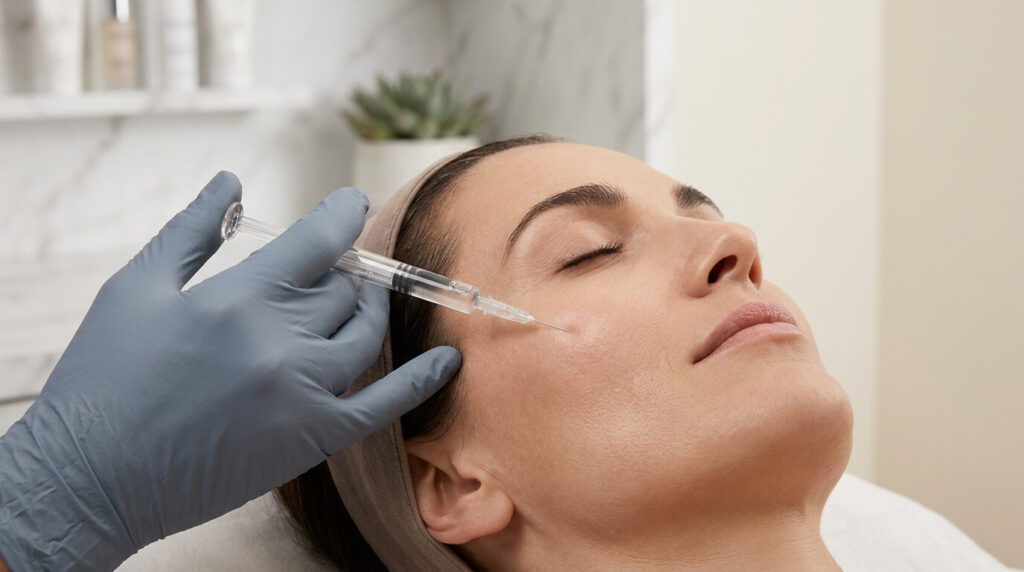
Hyaluronic acid filler restores volume in specific places. Placed in the cheeks, it can bring back midface support that lifts the folds around the nose and mouth and softens hollowing under the eyes. Ervin Beauty offers cheek filler for mid-face volume and contour, and the same principles apply to the chin, the jawline and the temples. The aim is to address a specific change in the anatomy. Adding volume everywhere to compensate for one hollow tends to look heavy.
Biostimulators
Collagen-stimulating injectables often enter the plan in this decade. Sculptra uses poly-L-lactic acid to prompt the body to produce its own collagen. The effect is gradual: manufacturer information describes a typical course of two to three sessions spaced weeks apart, with results building over several months and lasting up to two years in clinical follow-up. Radiesse is calcium hydroxylapatite and works in two ways, giving immediate structural lift and stimulating collagen over time. At Ervin Beauty, Radiesse results last 12 to 18 months, and Sculptra appointments take about an hour. Our guide to Sculptra and Radiesse explains the differences and who suits each.
Neuromodulators in a wider role
Botox continues to matter, and its uses expand. Beyond forehead and frown lines, it can soften muscle bands in the neck, slim a strong jaw muscle and, in some faces, subtly lift the brow. The plan is usually more comprehensive than in the 30s, with several areas treated together.
Tightening and skin quality
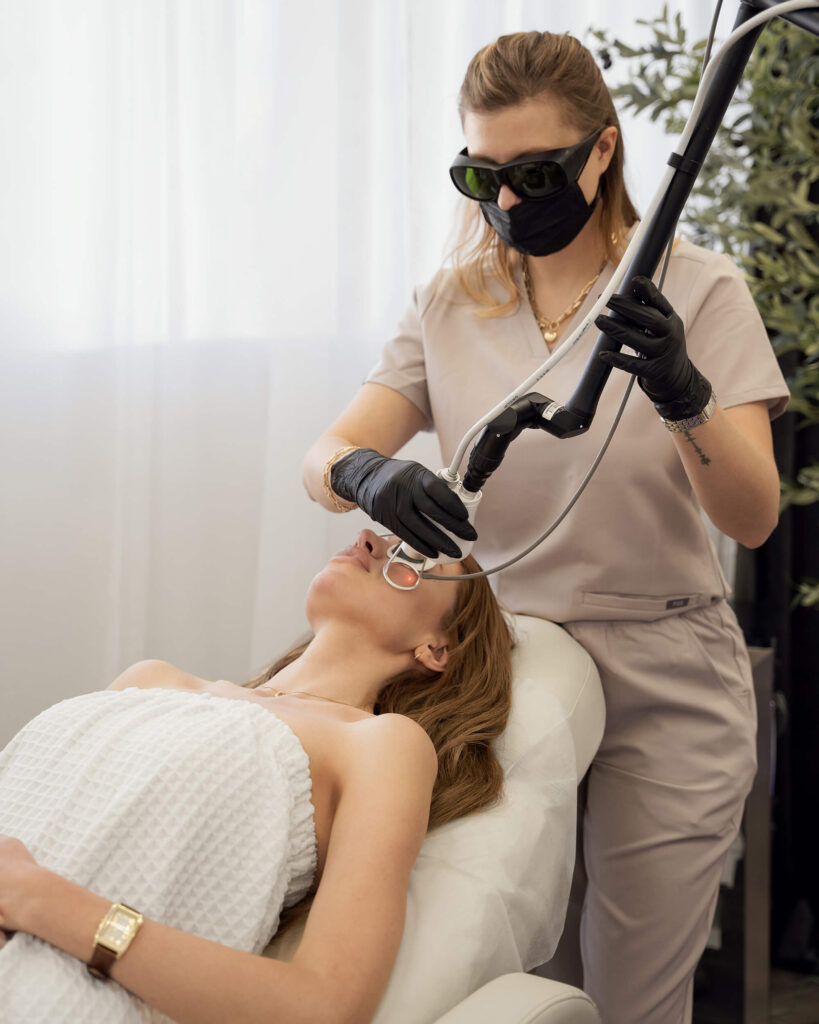
Early skin laxity is a common reason to add energy-based treatment. Morpheus8 Face combines radiofrequency with microneedling to target collagen remodeling, texture and mild lifting. HIFU is another option for tightening, and it works at a deeper level. Both are used for mild to moderate laxity and need realistic expectations. They improve firmness and texture but do not replace the structural lift of surgery.
In your 50s: comprehensive restoration and maintenance
By the 50s, changes in all the layers are usually visible together: bone loss, fat atrophy and descent, thinner skin, lower collagen and elastin, and more pronounced jowls and neck changes. Patients who have treated consistently in earlier decades often find that their results hold up well, and the plan here focuses on maintenance. Those starting later can still see a clear improvement, though the approach tends to combine more modalities.
Structure and contour
Filler remains central, and treatment often extends beyond the midface to the temples, the jaw and the chin, where bone loss and fat descent change the lower face’s outline. Biostimulators suit diffuse volume loss over a wider area, since they build tissue gradually and look natural when treating broad hollows. A plan for the lower face may combine structural filler along the jaw and chin with support in the cheeks.
Lifting and tightening
When laxity is more advanced, devices and procedures that act on deeper layers come into play. HIFU targets the layer that supports the face, and radiofrequency microneedling remodels collagen. Endolift uses a laser delivered under the skin for tightening in the face and neck, and PDO threads provide a degree of lift and support. Each has indications, limits and a different recovery. Our guides to Endolift and PDO threads go into the detail, and your provider can recommend which fits your anatomy.
Resurfacing and skin quality
Sun damage, uneven tone and fine wrinkling become more visible in this decade. Light-based treatments, chemical peels and CO2 laser resurfacing address texture and pigment at different depths, with different downtime. PRF and microneedling together may support skin thickness, especially where the skin has thinned, such as under the eyes.
Being honest about the ceiling
Non-surgical treatment can do a great deal, and it has limits. Significant skin excess, pronounced jowls or heavy neck changes may be beyond what injectables and devices can reach, and surgery may give a better result. A good provider will tell you when that is the case, instead of stacking treatments that cannot deliver what you want.
Common missteps at any age
A few patterns show up often enough to be worth naming.
Treating too much at once. Starting with a long list of treatments makes it hard to know what produced which change, and it raises the chance of an overdone look. Staging the plan gives you information after each step.
Chasing a single area. A hollow under the eye, a deep fold beside the nose and a softening jaw can all trace back to the same loss of midface support. Filling each one separately uses more product and often looks less natural than treating the cause.
Skipping the skin. Volume and muscle treatments change structure and movement, and they do little for dull, uneven or thinning skin. A face with good structure and tired skin still looks tired, so skin quality deserves a place in the plan at every age.
Comparing yourself with someone else’s results. Bone structure, skin thickness, fat distribution and metabolism differ from person to person, so the same treatment produces a different change on different faces. A photo of another person’s result says little about what to expect on yours.
Waiting for a problem to become obvious. Starting earlier usually means smaller doses and a lighter touch. Starting later is also fine, and the plan simply includes more steps. Neither approach is wrong, and the right moment is when you want to see a change.
Expecting surgery-level results. Non-surgical treatment refines and supports. When the goal is to remove excess skin or reposition tissue substantially, a surgical opinion is the honest next step.
Consistency matters more than any single treatment
The patients who look consistently refreshed over many years are rarely the ones who had a large treatment once. They are the ones who treated regularly at a moderate pace. Neuromodulators wear off in a few months and work best when repeated before the muscles fully recover. Filler is easier to maintain with a small top-up than to rebuild from nothing. Collagen-stimulating and skin quality treatments build on one another across sessions.
Consistency also tends to cost less in the long run, and it allows a lighter touch. Small adjustments made over time look natural, because the face never changes abruptly. A person who has been treated steadily for ten years often looks like a well-rested version of themselves, and not like someone who has had work done.
How to build a plan that fits
A useful plan starts with what bothers you most. Pick the one or two concerns you notice every day, and begin there. A first appointment rarely needs to address everything.
Next, match each concern to the layer causing it. Lines at rest and expression creases point to muscle activity. Hollows and flattened contours point to volume. Dull, thin or textured skin points to skin quality. Sagging along the jaw and neck points to laxity. Several of these often coexist, and the order in which you treat them matters. Volume and structure often come before fine-tuning of lines, and tightening and skin quality can be layered around them.
Finally, spread the plan over time. Treatments can be sequenced across months, which gives the face time to settle between steps and lets you judge each result before adding the next. It also spreads the cost.
What to expect at an Ervin Beauty consultation
A consultation involves looking at your face at rest and in motion, discussing what you want to change and what you would like to leave alone, and reviewing your medical history, any prior treatments and your timeline. The provider explains suitability, options, risks and expected recovery before any treatment begins, as noted on each of the clinic’s treatment pages, and results vary between patients.
Bringing a photo of yourself from several years ago can help. It shows the actual changes in your own face, which is a better guide than a photo of someone else.
Frequently asked questions
What are the best anti-aging treatments in your 30s?
Common choices include preventative Botox to soften expression lines before they set, skin quality treatments such as microneedling, peels or skin boosters, and selective filler for balance or lip and chin shape. The goal in this decade is to support the skin and slow the progression of lines while the structure is still largely intact.
When should I start getting filler?
There is no single age. Some people choose filler in their 20s or 30s for lip shape or facial balance, and others begin when volume loss starts to affect their face in their 40s. The right time is when filler addresses something you want to change, and a consultation can help you decide.
Is Sculptra worth it in your 40s?
For people with gradual volume loss over a broad area, Sculptra is a common choice because it builds collagen over time and the results look natural. Manufacturer information describes a course of two to three sessions with results lasting up to two years. Whether it suits you depends on your anatomy and goals.
What is the most effective anti-aging treatment?
No single treatment is the most effective, because different treatments address different changes. Neuromodulators soften muscle-related lines, filler restores volume, biostimulators build collagen, and energy-based devices improve firmness and texture. The best results usually come from combining the right treatments in a sensible order.
How do I start an anti-aging plan?
Begin with a consultation. Describe the concerns that bother you most, review what is driving them and agree on a first step. A staged plan, with each stage reviewed before the next, tends to give the most natural outcome.