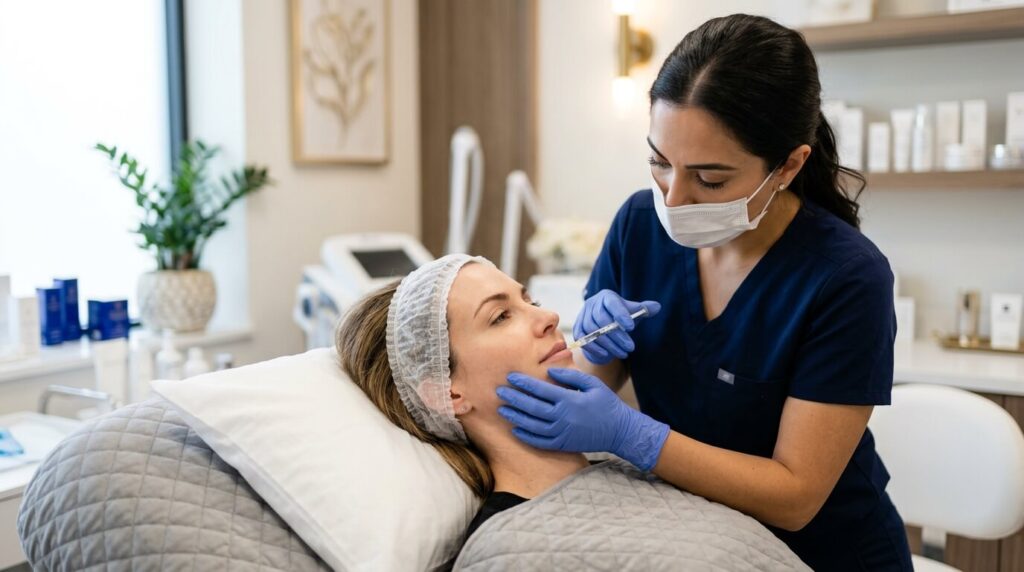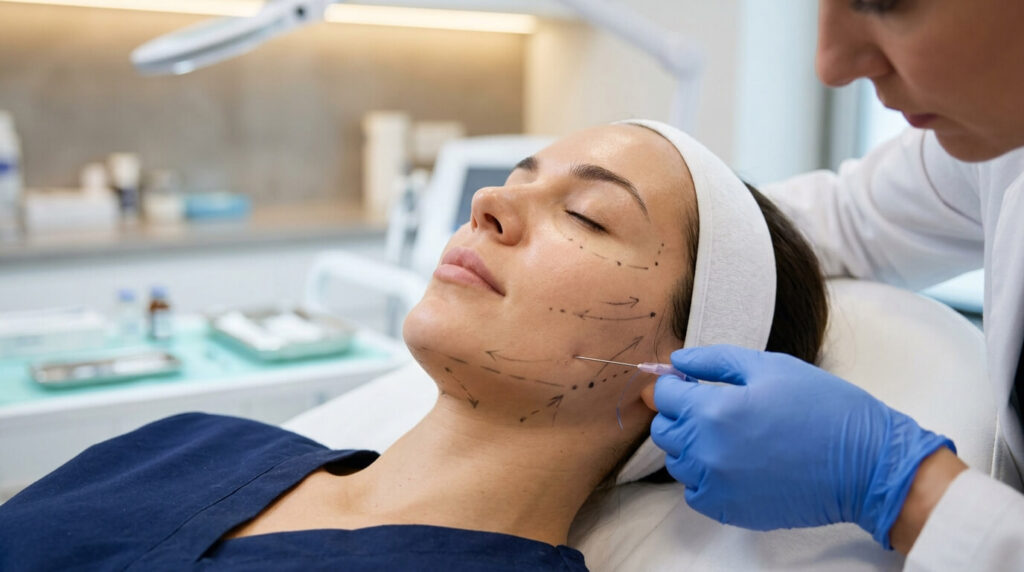
The neck is often the part of aging that people notice in themselves before anyone points it out — in a photo taken from a slightly lower angle, in a video call window, in the mirror under overhead light. It’s also one of the hardest areas to treat well, for reasons that have less to do with the technology available and more to do with the anatomy involved. This is a closer look at why the neck behaves differently from the rest of the face, and how Endolift’s approach is suited to it.
Why the Neck Ages the Way It Does
Neck skin is thinner than facial skin almost everywhere else on the body, with fewer oil glands and less underlying support structure. That thinness is part of why the neck often shows visible aging earlier than the face — fine lines, loss of elasticity, and the beginning of laxity tend to appear here before they’re obvious on the cheeks or forehead.
Underneath that thin skin sits the platysma, a broad, flat muscle that runs from the collarbone up to the jawline. As the platysma loses tone over time, and as the fibrous support structures connecting skin to the deeper tissue weaken, the result is the combination most people associate with an aging neck: loosening skin, softening of the jawline border, and in some cases visible vertical bands when the platysma muscle separates.
Submental fat — the tissue under the chin, commonly described as a double chin — is a separate but related concern. It can develop independently of skin laxity, coexist with it, or worsen its visual effect, which is part of why “neck concerns” often really means two or three overlapping issues at once rather than a single problem with a single fix.
Why the Neck Is Difficult to Treat With External Devices
Most non-surgical skin-tightening devices work by delivering energy through the skin’s surface — radiofrequency, ultrasound, or light-based systems all have to pass through the epidermis and dermis before reaching the deeper tissue where structural laxity actually originates.
On the face, where skin is comparatively thicker, this works reasonably well. On the neck, the thinness of the skin limits how much energy can be delivered from the outside without risking surface damage or discomfort that outweighs the benefit. This is a large part of why neck results from purely external devices are often described, even by providers who use them regularly, as more modest and more variable than results on the face treated with the same technology.
How Endolift Addresses This
Endolift bypasses the problem of working through the skin’s surface by delivering laser energy through a thin optical fiber placed directly beneath the skin. For the neck specifically, this matters more than it does almost anywhere else on the body, because it removes the main limitation that makes external devices inconsistent in this area.
The fiber is guided beneath the neck skin along the treatment zone, producing two effects. The first is immediate thermal contraction of the collagen in the treated tissue — a tightening effect that begins during the procedure itself. The second is longer-term: the treatment stimulates new collagen and elastin production in the weeks and months that follow, which is what produces the more structural, longer-lasting improvement.
Where submental fat is part of the concern, the same laser energy also affects the fat tissue directly, producing a degree of fat remodeling alongside the skin tightening. This dual action is relevant for patients dealing with the combination of loose skin and fullness under the chin, since addressing only one of the two rarely produces a fully satisfying result on its own.
What the Procedure Looks Like for the Neck
At Ervin Beauty, neck treatment is offered as part of the Face & Neck package, priced at $3,200 for a single session that extends the same Endolift procedure used on the face to include the neck for a fuller lower-face and neck result. The session is performed under local anesthesia, with entry points smaller than a millimeter along the treatment path.
Neck tissue, being thinner and more prone to fluid retention than the cheeks or jawline, tends to show more visible swelling in the first 48 hours than facial treatment alone. This is a normal part of the pattern rather than a sign that anything went differently than expected, and it typically resolves within the same three-to-five-day window described for facial treatment, sometimes extending slightly longer for more extensive neck correction.
What Results Typically Look Like
Results on the neck follow the same general timeline as facial Endolift: an early, subtle tightening visible within the first couple of weeks as swelling resolves, followed by a more gradual, structural improvement as collagen remodeling continues over the following months. The fuller result is generally assessed at three to six months, consistent with what’s described for the Face & Neck treatment.
It’s worth being specific about what Endolift can and can’t do on the neck, since expectations here matter more than almost anywhere else in aesthetic treatment.
What it addresses well: mild to moderate skin laxity, early jawline softening extending into the neck, submental fullness combined with loose overlying skin, and the general loss of definition between the jaw and neck that develops gradually with age.
What it doesn’t replace: significant excess skin that has lost most of its elastic capacity, and pronounced platysmal banding caused by muscle separation rather than skin laxity alone. Both of these are better addressed surgically, and a provider doing a proper assessment should say so plainly rather than positioning Endolift as a fix for a concern it isn’t suited to.
Endolift, Platysmal Bands, and Combination Treatment
Vertical bands that become visible on the neck, particularly when the muscles are tensed, come from separation of the platysma muscle rather than skin laxity on its own. Endolift’s effect is on the skin and subcutaneous tissue, not the muscle itself, so it doesn’t directly correct significant platysmal banding the way a surgical platysmaplasty does.
For patients with mild banding alongside skin laxity, some providers combine Endolift with a small amount of neurotoxin placed along the platysma to soften the band’s visibility — sometimes referred to informally as a neck lift injection approach. Whether this combination is appropriate depends on the individual presentation and is a conversation for the consultation, not a default recommendation, since not every patient with visible bands is a good candidate for this specific pairing.
Endolift Neck vs. a Surgical Neck Lift
This comparison is worth making honestly, because the two treatments are not interchangeable, even though they’re sometimes discussed as if they compete directly for the same patient.
A surgical neck lift physically removes excess skin and can directly address platysmal banding by suturing the muscle back into position — corrections that no non-surgical treatment can fully replicate. The average surgeon’s fee for a neck lift in the U.S. runs roughly $7,500 to $13,000, before anesthesia and facility costs are added, and recovery involves incisions, sutures, and a multi-week healing process.
Endolift for the neck costs a fraction of that, involves no incisions or sutures, and returns most patients to normal activity within days rather than weeks. What it doesn’t do is remove excess skin or correct muscle separation directly. For patients with early to moderate neck laxity who aren’t excess-skin candidates, Endolift often addresses the concern well. For patients who’ve already reached the point of significant loose skin or pronounced banding, a surgical consultation is the more honest recommendation, and a provider who steers every neck concern toward Endolift regardless of severity isn’t doing the patient a favor.
Who Tends to Get the Best Results
Patients who see the most satisfying outcomes from neck-focused Endolift tend to share a few characteristics: they’re in the earlier stages of visible neck aging rather than advanced laxity, they have realistic expectations about a multi-month results timeline rather than an immediate transformation, and they’re treating the neck alongside the face rather than in isolation, since the two areas age together and tend to look most balanced when addressed together.
Patients who are less likely to be satisfied are typically those expecting a result equivalent to surgical skin removal, or those with significant platysmal banding who haven’t been told, before treatment, that this specific concern falls outside what Endolift is designed to correct.
Preparing for Neck-Focused Treatment
A handful of practical steps in the days before treatment make the procedure and the early recovery smoother, and most providers cover these during the pre-treatment consultation rather than leaving patients to guess:
Avoiding blood thinners where medically appropriate. Aspirin, fish oil, and similar supplements increase bruising risk, and providers typically ask patients to pause these for a period before treatment, in coordination with a physician if the medication is prescribed rather than optional.
Limiting alcohol in the day or two beforehand. Alcohol has a mild blood-thinning effect that can increase visible bruising, particularly relevant for the neck given how readily that area shows bruising compared to other facial zones.
Arriving with realistic scheduling in mind. Because neck swelling tends to be more visible than facial swelling in the first two days, patients planning treatment around a specific event should build in more buffer time than they might for facial-only treatment — the planning guidance in our recovery timeline article covers this in more detail.
Discussing any history of neck-area procedures. Prior thread lifts, filler, or neurotoxin placed in or near the neck are relevant information for a provider planning Endolift, since treatment history affects how the tissue responds and what combination approach makes sense.
None of these steps are complicated, but skipping them is one of the more common reasons a patient’s actual recovery differs from what they expected going in.
Frequently Asked Questions
Technically yes, though most providers, including at Ervin Beauty, offer neck treatment as part of a combined Face & Neck package, since the two areas typically age together and produce a more balanced result when addressed as a unit.
Endolift addresses submental fat and the overlying skin together, which often produces a noticeably improved contour, but the degree of improvement depends on how much fat is present and how much of the concern is skin laxity versus fat volume. A consultation that assesses both factors gives a more accurate expectation than a general answer can.
Neck skin tends to swell more visibly in the first two days due to its thinness and tendency to retain fluid, but it generally follows the same overall healing and results timeline as facial treatment.
The subdermal delivery method is part of why Endolift is well suited to the neck specifically — because the energy is delivered beneath the skin rather than through it, the surface-damage risk that limits some external devices on thin neck skin doesn’t apply in the same way. Performed by an experienced provider, it’s considered appropriate for this area.
Both follow a similar durability pattern, with many patients maintaining results for multiple years as the new collagen structure holds. The neck is a higher-movement, higher-exposure area in daily life, so ongoing sun protection and general skin care play a role in how long any tightening result is preserved.
Neck treatment is most often planned alongside the face rather than on its own — Endolift — Face & Neck covers what that combined treatment includes. For a fuller picture of how the procedure works and what it addresses beyond the neck, our complete guide to Endolift Laser is the place to start, and our breakdown of what Endolift costs and what drives the price covers how the Face & Neck package compares to treating the face alone.