Dark circles, hollows and a permanently tired look under the eyes get lumped together as one concern. In the treatment room they are several different problems, and each responds to a different approach. A shadow caused by a hollow groove needs something that fills the groove. Thin, translucent skin that shows the blood vessels beneath it needs something that improves the skin itself. Brown pigmentation needs a third strategy altogether. Choosing a treatment before knowing which problem you have is the most common reason under-eye results disappoint.
At Ervin Beauty in Studio City, the under-eye area can be approached with hyaluronic acid filler, with PRP made from your own blood, or with PRF EZ Gel, which is another blood-derived preparation. This guide compares filler with the blood-derived options: how each one works, what it can realistically change, how the appointments differ and how to work out which suits your eyes. For a deeper look at PRP on its own, our article on PRP under the eyes covers the topic in detail.
Why the under-eye area looks tired
The skin under the eye is among the thinnest on the body. It sits over a muscle that circles the eye, a thin layer of fat and the bony rim of the eye socket, and there is little cushioning between the surface and the structures below. Several changes, often occurring together, can make the area look tired.
Volume loss. With age, the fat beneath the eye thins and the cheek fat shifts downward. The bony socket also gradually widens. A groove forms between the lower lid and the cheek, known as the tear trough, and it casts a shadow that reads as darkness even when the skin itself is not discolored.
Thin, translucent skin. As collagen declines, the skin becomes more see-through, and the blue and purple tones of the vessels beneath show through. This tends to look darker in people with fair or thin skin.
Pigmentation. Some people have brown discoloration in the skin of the lower lid, often inherited, sometimes worsened by sun exposure or irritation.
Puffiness and bulging fat. Fat that pushes forward, or fluid that collects, creates a bulge that can be mistaken for hollowness and make the shadow below it deeper.
Many people have a mixture. A simple test is to look in a mirror with light coming from above and then from below. If the dark area changes or disappears as the light shifts, shadowing from a hollow is a major factor. If the color stays the same in any light, the cause is more likely skin tone, translucency or pigment.
How under-eye filler works
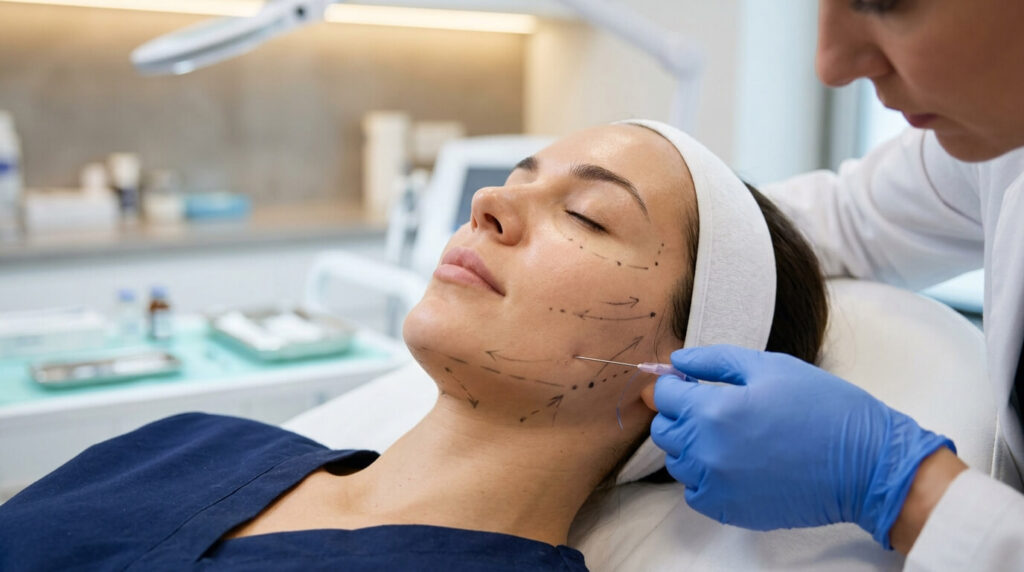
Filler addresses volume. A soft hyaluronic acid gel is placed into the tear trough to lift the hollow and smooth the transition between the lower lid and the cheek. When the groove is filled, light reflects more evenly and the shadow softens. At Ervin Beauty, under-eye filler is described as hyaluronic acid injected into the tear troughs to reduce the appearance of hollowness and shadows, and the appointment takes about 45 minutes.
The change is immediate. There is no waiting period for the effect to build, although a little swelling in the first days can hide the final look. Because the result comes from product placed in the tissue, it also fades as the body breaks the gel down, and many patients return for a refresh after several months to a year, depending on the product and how quickly their body processes it.
Why technique matters so much here
The under-eye is one of the most technique-sensitive zones on the face. The skin is thin, the blood supply is rich and the margin between a smooth result and a visible one is small. Injectors who treat this area regularly tend to rely on a few principles.
They use a soft, low-viscosity gel that spreads evenly and does not feel firm under thin skin. They place it deep, close to the bone, and avoid putting product in the superficial layers. They often use a blunt-tipped cannula, which can reduce bruising and lowers the chance of piercing a vessel compared with a sharp needle. And they work in small amounts, because overcorrection is easy to produce. One clinician in the ophthalmology literature describes using no more than half a milliliter per eye in a session, as an example of how conservative the approach can be.
What can go wrong
Three issues are worth knowing about.
The first is the Tyndall effect, a blue-gray tint that appears when hyaluronic acid sits too close to the skin surface and scatters light. It is a technique problem, and it can usually be corrected with hyaluronidase, the enzyme that dissolves hyaluronic acid filler.
The second is swelling and puffiness. The tear trough lies close to the area where fluid collects, and filler, which attracts water, can leave some people with persistent puffiness or a visible mound along the cheek. Overfilling raises the risk, and so does placing product in an area that was not truly hollow to begin with.
The third is the rare vascular complication, where filler enters or blocks a blood vessel. The vessels around the eye connect to circulation in the eye itself, and this complication can threaten vision. It is uncommon, and it is the reason experienced injectors use careful technique and keep hyaluronidase on hand. Pain out of proportion, a pale or mottled patch of skin or any change in vision after an injection needs urgent attention.
Because hyaluronic acid can be dissolved, filler placed near the eye retains an important safety margin that other filler types lack. This is why hyaluronic acid is the standard choice for this area.
How PRP and PRF EZ Gel work
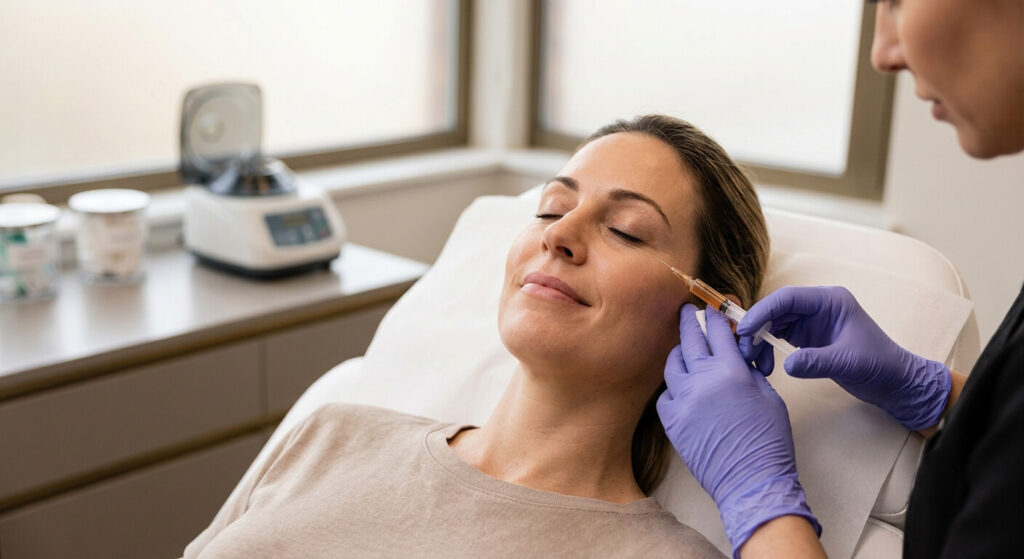
PRP and PRF take a different route. Instead of adding a manufactured gel, they use a preparation made from a sample of your own blood. After assessment and consent, blood is drawn and processed, and the resulting preparation is placed in the planned area.
At Ervin Beauty, PRP under the eyes uses liquid platelet-rich plasma. The clinic’s own description notes that dark circles, hollowing, puffiness and fine lines are not the same problem, and that a consultation should determine whether PRP is appropriate for the specific cause. PRF EZ Gel is a different preparation, combining processed plasma gel with platelet-rich fibrin concentrate, and it is priced and planned by zone. Liquid PRP, PRF EZ Gel and hyaluronic acid filler are three distinct treatments, and it helps to ask your provider exactly which one is being proposed.
The idea behind these treatments is that platelets carry growth factors, which are signaling molecules involved in tissue repair. When they are placed in the skin, they are thought to prompt fibroblasts, the cells that make collagen, to become more active. Over weeks to months, the skin may become somewhat thicker and denser. That is the reason blood-derived treatments are usually discussed for skin quality, meaning texture, fine lines and the translucent look of thin skin, rather than for filling a groove.
What evidence and experience suggest
Smaller studies and clinical experience suggest that PRP and PRF can improve under-eye skin quality, and some reports show modest improvement in dark circles and fine lines. The research is still developing, and results are gradual and moderate. Providers who use these treatments describe the benefit as bounded: better skin quality, not a surgical-grade change. One point of consistent agreement among clinicians is that a blood-derived preparation does not replace the volume in a true tear trough hollow. Some practitioners suggest that PRF may suit texture and fine lines, while PRP may suit pigmentation and darkness more, though the best choice depends on the individual.
Ervin Beauty’s own treatment pages are careful on this point, noting that results vary and may not occur for all patients, and that evidence and expectations should be discussed at consultation. That cautious framing is worth keeping in mind when you compare any under-eye option.
Sessions and timing
Blood-derived treatments are usually planned as a series. Many providers describe a course of two to four sessions spaced several weeks apart, followed by occasional maintenance, though the exact plan depends on the preparation used and the concern being treated. Results build slowly. Early changes in skin texture and brightness often take a few weeks to appear and continue to develop over the following months.
Filler vs PRP and PRF EZ Gel, side by side
| Under-eye filler | PRP or PRF EZ Gel | |
| Source | Manufactured hyaluronic acid gel | Preparation from your own blood |
| Main target | Hollow tear trough and its shadow | Skin quality, texture, thin or translucent skin |
| Speed of result | Immediate, with early swelling | Gradual over weeks to months |
| Number of visits | Often one, with touch-ups | Usually a series of sessions |
| Duration | Fades as the gel breaks down | Builds with collagen response, maintenance as needed |
| Can it fill a groove | Yes | No |
| Can it be dissolved | Yes, with hyaluronidase | Not applicable |
| Appointment includes | Assessment and injection | Assessment, blood draw, processing and injection |
| Main risks | Tyndall effect, puffiness, rare vascular complication | Bruising, swelling, uneven response |
Matching the treatment to the cause
Working back from what you see in the mirror is the most reliable way to decide.
A clear hollow with a shadow beneath it. If the groove is visible and the shadow shifts with the light, filler is the treatment that changes the groove. A blood-derived treatment is unlikely to lift a true hollow.
Thin, crepey or translucent skin with little hollowing. If the area looks shadowed mainly because the skin is thin, with fine lines and a bluish tone, improving skin quality is a reasonable first step. PRP or PRF EZ Gel is the type of treatment typically considered here, and the plan should include realistic expectations about the degree of change.
Brown pigmentation. Pigment is a skin issue that neither filler nor a blood-derived preparation reliably treats on its own. Other options, such as topical regimens or light and chemical-based treatments, are discussed separately, and your provider can advise which is appropriate for your skin.
Bulging fat or persistent puffiness. Filler can worsen a bulge, and a blood-derived treatment will not remove it. This pattern calls for a different conversation, and sometimes a referral.
A mix of volume and skin quality. Many patients fall here. A combined plan, with a small amount of filler for the hollow and a blood-derived treatment for the skin, is a common approach among practitioners, and the order can vary. Some start with skin quality, others with volume. The sequence is a judgment based on how your eyes look in person.
What happens at a consultation
An under-eye consultation begins with a close look at the area in different lighting and with your face relaxed and animated. The provider considers the depth of the groove, the quality and color of the skin, the presence of any bulge, the cheek position and your medical history. They will ask what bothers you most, since the answer shapes the plan, and a patient who dislikes shadow needs different treatment than one who dislikes crepey texture.
An honest consultation sometimes ends with a recommendation not to treat. If the main issue is a bulge, a surgical consultation may be more suitable. If the hollow is mild and the skin is healthy, waiting may be reasonable. If the problem is mostly pigment, filler would not help. A provider who tells you this is protecting your result.
Preparing and recovering
For either approach, tell your provider about medications and supplements that thin the blood, since bruising near the eye is more visible and lasts longer than elsewhere. Filler typically brings swelling and possible bruising for a few days, and cold compresses and sleeping with your head slightly raised help. A blood-derived treatment involves a blood draw, and the treated area can be swollen and bruised for a few days. Makeup can generally be applied once the skin has settled, according to your provider’s instructions. Avoid rubbing the area, intense exercise and heat on the first day.
Questions worth asking before you book
- What do you think is causing my under-eye concern, and how do you tell?
- Which exact product or preparation do you recommend, and why?
- How much will you use in the first session, and do you build gradually?
- What technique and depth do you use, and have you treated this area often?
- What happens if I develop swelling, a bluish tint or lumps?
- How many sessions will I need, and what will the results look like at each stage?
Clear, specific answers to these questions tell you much more about a provider than a photo gallery does.
Frequently asked questions
What is the difference between under-eye filler and PRP or PRF?
Filler is a hyaluronic acid gel that adds volume to the tear trough and gives an immediate change. PRP and PRF EZ Gel are made from your own blood and are used to support skin quality over weeks to months. Filler addresses hollows. Blood-derived treatments address skin thinness, texture and tone.
Which is better for dark circles?
It depends on the cause. If the darkness is a shadow from a hollow groove, filler is the more direct option. If it comes from thin, translucent skin, a blood-derived treatment may be more suitable. If pigment is the cause, neither is the main answer, and a consultation can clarify which applies.
How long do the results last?
Filler fades gradually as the body breaks the gel down, and many patients refresh it after several months to a year. PRP and PRF results build over a series of sessions, and maintenance is planned individually. Metabolism, the product and the amount all influence the timeline.
Can under-eye filler and PRP or PRF be combined?
Yes. Many providers combine a small amount of filler for the hollow with a blood-derived treatment for skin quality when both are present. The order and timing depend on your anatomy and your provider’s approach.
Is under-eye filler safe?
It is a well-established treatment when performed by a trained injector who understands the anatomy of the eye area. Hyaluronic acid can be dissolved if needed, which is a significant safety advantage. Risks include swelling, bruising, a bluish tint if placed too superficially and, rarely, vascular complications that need urgent care. Results vary and are not guaranteed.